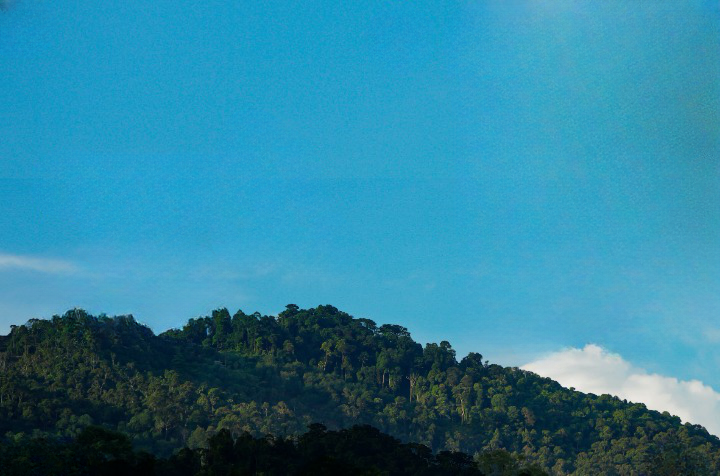
GROWING UP IN the foothills of the Penanghighlands, the towering heights — ever verdant, ever extant — always acted as the backdrop to my young life. It comforted with its weighty presence, albeit that its vibrancy often suggested danger. One has to be cautious climbing the slopes. Scorpions, snakes and spiders were always around, always enchanting but always mysterious in the eyes of a small boy.
If I ascended high enough up the hills, far above the rifle range where soldiers practiced firing off their designated rounds of bullets every Sunday, eastwards I would eye vegetable farms a mile away. To the left lay acres of grey gravestones. Often dry, the Batu Gantung cemetery is but one of several such huge plots of land whose sloping nature destined them to become Chinese burial grounds. To the right, much further away, and not always visible, is the Batu Lanchang cemetery. Far to the south, beyond sight from the Air Puteh hills and beyond the market village of Air Itam, lay the sprawling Paya Terubong cemetery. These three cemeteries, to my young mind, drew the western boundaries of urban Penang. This space was, in many ways, the bread basket of George Town. Its slopes grew fruits while its waters nurtured vegetables and fish to supply the wet markets.
It’s a paradox, isn’t it, that one can grow up on a small island like Penang, and be more a hillbilly than a boatman. But that is, of course, one of the treasures of Penang life. The hills have your back and provide psychological relief, and the sea offers you adventure and opportunities.
Growing Beyond Insularity
I only grew to know the sea after I began cycling. The traffic was not a challenge back then for any youngster wishing to discover the countless hidden parts of Penang Island. Back then, one could pedal safely around the island and ascertain that we did indeed live on an island… small enough to explore as a boy but big enough to excite the imagination.
Seeing the Indian Ocean as one descends at great speed into Balik Pulau on the west side of the island is an unforgettable experience. The sight stays still in my mind, more deeply than the barren sands of Batu Ferringhi do.
Gurney Drive was another joyful destination for cyclists on gearless bikes.
Cheap food and cheap drinks were always available throughout the island. Hunger was easily stilled, thirst easily quenched.
Going to secondary school in the town introduced me to the coastlines of the cape on which George Town stands. Before the first bridge was built, these were clearly where Penang ended and the world began. Butterworth was like a familiar twin that one visited by ferry once in a long while as a reminder that there was a world beyond the island, and one could actually take small steps to explore this unknown territory.
As one learns about the world, and about Malaysian demographic history, one also learns that most of Penang’s communities originated overseas. Their arrivals being before we had planes and airports, practically every family would have come by boat to this place, some from as far away as Acheh, the Sulawesi, China, India, Europe… you name it.
Some stayed in the port areas to live off the transporting of people and goods to and from Penang, while others ended up living on jetties, unable to decide if sea was better or land, like amphibians. Then, there were those who became proper landlubbers like my family who moved far inland, to the foothills.
A port society like Penang’s makes it quite impossible for anyone living on it to ever forget the enormity and diversity of the planet. There are too many signs of bigger things in the bigger world.
For a place like Penang, its uniqueness lies in its insularity remaining tempered by globalism, its cosmopolitanism staying dynamic, and its economy retaining international relevance.
Perhaps that is why Penang has an unsolvable brain-drain and brawn-drain problem. If you are a people who came by sea, live by the sea and live off the sea even, you tend to suffer the imagination, the gumption and the option of sailing away one day. Or flying away.
And that inclination does not fade just because you grew up in the foothills of the island.

 Wikibeng
Discussion
No comments yet.