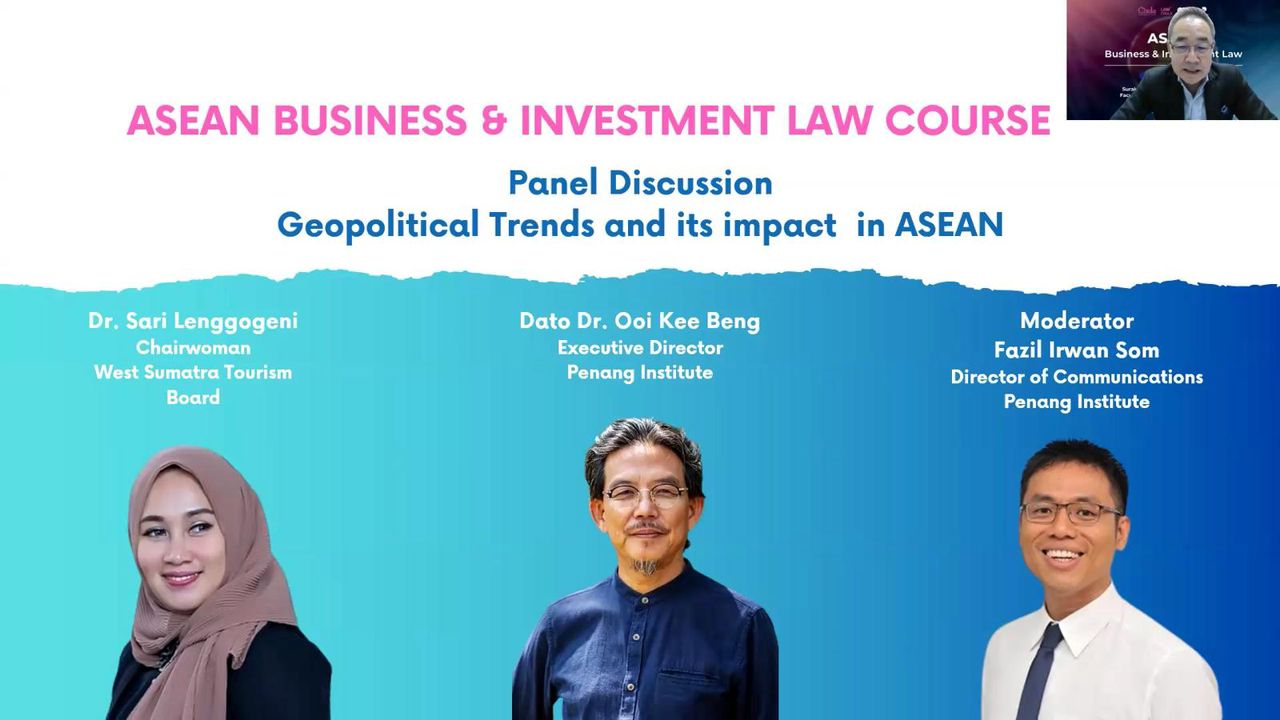
Online Lecture given by Ooi Kee Beng to the Master’s Class at the Law Faulty of Chulalongkorn University, on 14 March 2024.
Good morning everyone. I am most happy to have this chance to speak to all of you. I do miss lecturing, which I have only done sporadically ever since I left academia to do think tank work, back in 2004.
I feel that I should introduce myself and my academic background and interest to all of you before I start my talk. This is so that you can better comprehend where I am coming from intellectually.
I was born in Penang, lived most of my adult life, 26 years, in Sweden, and then 14 years in Singapore, before returning to Penang 7 years ago. I have also lived in Beijing and spent a lot of time in Dublin and London.
My major interests have been in Modern Political History, especially Nation building in Asia. My studies have been in Public Administration (Swedish system); Western Ethics; Sociology. My PhD was in Sinology within which I came to lecture at Stockholm University, NUS and City University in Hong Kong in the subjects of Chinese History and Chinese Philosophy. The case study for my thesis on nation building was Malaysia, where I tried to gain insights on the subject through the use of ancient Chinese political-scientific concepts.
Since 2004, I have been in think tank work, at ISEAS – Yusof Ishak Institute, to which I am still attached as a Senior Visiting Fellow, and since 2017, I have been running Penang Institute, a public policy think tank for the Malaysian state of Penang, as its Executive Director.
My main outputs have been through biographies of first-generation politicians in Malaysia and Singapore, and essays and think pieces on Malaysia and the Asian region.
OK, that’s enough about me.
ASEAN & SOUTHEAST ASIA
The subject I have been asked to speak about today has three parts. One is about “Geopolitical Trends” and the second is “ASEAN”, which I take to mean both the Association of Southeast Asian Nations as well as Southeast Asia as a geostrategic region. Thirdly, how the first impacts the second will then be the main discussion we will be having. Note that I will try to think of the impacting effect to be a two-way street, meaning (1) How do geopolitical trends today impact ASEAN; and (2) How does ASEAN, by its very nature, impact geopolitical trends today.
My talk will focus on four things then: ASEAN & Southeast Asia; Geopolitical trends; Impact of the latter on the former, and; the impact of the former on the latter. This is somewhat simplified, but let’s approach the issues that way and see how far we can go with it.
Let’s start with a few words about ASEAN. In what sense is Southeast Asia a region?
First of all, it is maritime territory, at least half of it. There are not all that many such regions in the world, the most important perhaps being the Mediterranean. We could point to the West Indies perhaps, maybe even the Baltic Sea or the Yellow Sea. In the case of Southeast Asia, we have to immediate cut the region into a mainland and a archipelagic section. Mainland Southeast Asia is basically what the French called Indochine. Maritime Southeast Asia is basically what we call the Nusantara. Apparently, the British in the 19th century would on occasion refer to the Nusantara as “Further India”.
We have the Indian Ocean and the Andaman Sea to the west, and the Pacific to the east. Running down the middle, we have the Straits of Melaka and the South China Sea.
On the mainland, we have huge great river systems—the Irrawaddy, the Salween, the Mekong, and the Chao Phraya, not mention the Red River delta and the Tonle Sap.
The Chinese called the seas south of their coastline the Nanhai, or the Nanyang—the Southern Seas.
Today, we can roughly say that populations on mainland Southeast Asia exhibit a strong Hindu-Buddhist cultural base, in contrast to the archipelago where a Hindu-Muslim base is more prevalent. To complicate matters, the northern Philippines has a largely Catholic population, and Christians can be found in various places throughout the region.
Needless to say, colonial influences remain obvious, smoothly blending into what we may call “Modern Culture”. More often than not, nation building in all the newly formed countries has been about adaptation and adoption of nation-state political paradigms.
To quote Wang Gungwu, the colonial powers were “national empires” claiming territories and controlling trade routes, and these mistrusted each other and this part of the world, it all ended with the Japanese “national empire” pushing all European national empires back, beyond the Andaman Sea.
While losing in the end, the Japanese occupation of most of East Asia changed not only the political boundaries but also the aspirations of colonised populations in region.
It was during the Second World War that the term “Southeast Asia” was coined—in the form of the Southeast Asia Command, and to denote this newly-emerged buffer between British India and Japan, consisting of the lost colonies of the European national empires.
After the war, we note that a new world had emerged. These former colonies were not going to remain colonies, especially not of powers that could be so easily beaten by a newly modernised Asian power, and who in many cases had left their colonies at the mercy of the new invader.
And the only format possible for them to adopt was that of the nation-state. The formation of the United Nations Organisations anchored international political thinking to that of the nation-state ideal with its precise boundaries, rules of citizenship, control over mobility of all things possible, financial and currency sovereignty, and so on and so forth. Many of these were alien concepts, and this would include apparently neutral concepts like Power, Leadership, Followship, Nationalism, and even Economics.
By then, the global war that we know as WWII had transformed into the Cold War, and that would last until 1991. What this means is that practically all countries throughout Asia (and Africa) actually came into being under the polarising spotlight of the Communism-Capitalism Conflict.
The institutions created then were largely to serve one or the other side, one may venture. Or at least to favour one over the other.
These included the UN itself of course, where a two-tier system was implemented despite the principle of equality among nations. There was of course security alliances such as NATO, and in Southeast Asia, we had SEATO and Five-Power Defence Agreements and other bilateral ones. Then there were the Bretton Woods system iinvolving the IMF and the IBRD. In this context, one could add the Trumen Doctrine for containment of the Soviet Union.
The Bretton Woods system aimed to make as unlikely as possible a recurrence of economic warfare and closed markets which had characterised the 1930s.
As we may assume, ASEAN was founded in 1967 to group the newly-founded administrations in maritime Southeast Asia which were anti-communist into a bulwark against the expected southward movement of Communism professed in the Domino Theory.
ASEAN’s five founding fathers—Indonesia, Malaysia, The Philippines, Singapore and Thailand—were stauntly fighting communist insurgencies of their own, while the mainland countries—Myanmar, Laos, Cambodia and Vietnam were embroiled military conflicts. Brunei joined ASEAN on being granted full independence in 1985.
Interestingly, and very tellingly, the mainland countries would join the organisation one by one only after the Cold War ended. By the turn of the century, ASEAN had ten members comprising of all independent countries between Australia, China and India. Timor Leste is on track to join the organisation.
What is interesting to note at this point is how ASEAN was concerned with strategic issues until the end of the Cold War, and we entered a period we may name the Unipolar period, with US calling shots, after which economic integration became the major objective. Apart from economic crises during that period, especially the Asian Financial Crisis of 1997-98, the region was greatly affected by the so-called War on Terror that followed the 911 incident in 2001. Officially, that War ended in 2022.
Meanwhile, China continued its path to become the manufacturing centre of the world, and an economic powerhouse, especially after joining the WTO in December 2001, practically surpassing the US in many areas. This signalled in all seriousness, the dawn of a new multipolar period in world history.
Today, when a trade war brews between China and the US, and may perhaps reach boiling point, how is ASEAN to adapt without being pulled apart by geopolitical trends?
GEOPOLITICAL TRENDS
What the history of ASEAN tells us, and that story can only be told within the shifting of global context, is that not only do geopolitical trends affect ASEAN, they were in fact the main force forcing ASEAN into being.
Without geopolitical trends permeating the region, ASEAN might not have come into being at all. If you add colonialism to geopolitical trends stretching back 400 years, or even just 200 years, then the countries that are members of ASEAN might not have come into being at all.
Or at least, one could say that the Southeast Asian countries as they look today were created by the evolving geopolitical trends of the era. That is also another way of saying that external forces have been overwhelming where Southeast Asian populations and politics, and indeed the composition of their multiculturalism, are concerned.
But where ASEAN as an organisation is concerned, we should not short-sell it and think of it as a puppet organisation under the sway of external powers. In fact, for many ASEAN member countries, establishing ASEAN was their way of holding external powers at bay.
The development of ASEAN over the last 30 years testifies to this. ASEAN in the driver’s seat, has been a popular way of perceiving the organisation. The many FTAs and the many ASEAN+ systems have all been strategically effective ways for ASEAN as a whole to punch above its weight or to demand due respect from others.
In 2003 came the Declaration of ASEAN Concord II, which aimed to establish the ASEAN Community. Indeed, regional integration through the three ASEAN communities initiated since 2009, stand as clear expressions of the ambitions of member states to use ASEAN to advance regional sovereignty, boost economic growth and enhance social integration. The ASEAN Political Security Community (APSC) blueprint and the ASEAN Economic Community (AEC) Blueprint were adopted in 2009, while the ASEAN Socio-Cultural Community (ASCC) Blueprint was adopted in 2015.
But then, in mid-2010s, the geopolitical situation had begun shifting radically, and today, in 2024, how ASEAN adapts and how ASEAN integration is being challenged in the new environment requires much new analysis. Will ASEAN survive the continued encroachment into the region of big power struggles. This time, the struggle is not only over security as in the first 20 years, it is just as much about trade partisanship.
Are the economic warfare and the closed systems of the 1930s, which the Bretton Woods agreement was meant to avoid, back again, this time focused around East and Southeast Asia?
While the “de-coupling” or “derisking” may sound like economic or even corporate strategies, they are in fact driven by a wish from the West and its allies to isolate China and to slow its economic growth.
This should worry all of us. China’s opening up since the 1980s gave hope that the division of the world into separate economic zones would soon end. And it did, at least until the 2010s when the successes of the Chinese economy, now seen as direct challenges to the US global system, became the target for US foreign policy. To be sure, that distrust had always been there, and it was mainly other distractions that had kept the US busy elsewhere.
Now it is the Ukraine War and the Gaza conflict. In both cases, discursive links to the China threat are being made in the western media. China remains the looming threat.
GEOPOLITICAL TRENDS AND THE IMPACT ON ASEAN, And VICE VERSA
Southeast Asia as a region is boundaried from without, geographically and strategically, rather than from some integral strength that it possesses. ASEAN, on the other hand, is a concerted effort by its member states, to find that integral strength.
As earlier noted, this region gained its present form by virtue of past geopolitical trends. In that sense as well, its member states are still searching for a balance between being viable nation states, and using regionalism to aid that process. ASEAN therefore gathers the political will of its members in order not only to have a voice globally, but also to manage its relations with Big Powers.
There is therefore always a serious tension between each basically insecure national administration watching over its own national interests, and tentatively using ASEAN to manage the world beyond. To complicate matters, each country has its own security legacies, domestic tensions, political weaknesses, and international allies. Also, the developmental and cultural gaps within ASEAN are enormous. New gaps become more relevant all the time as well, like the digital gap, population sizes and strategic significance, and also a growing sense of internal competition between the member states.
We can perhaps talk about three levels of concern for each country. First, the country’s survival and sovereignty must come first. To an extent, that is tied to its relations with regional neighbours. So, the rationale for ASEAN is a strong one—nationalism and regionalism are not easily separated. ASEAN is a natural defence mechanism for countries in the region, however immature it might still be. That is the second level of concern.
Making use of ASEAN to manage Big Powers should be more and more necessary the more attention these Big Powers give to the region, but this is where the weaknesses and perhaps immaturities in political understanding are exposed. ASEAN seems flatfooted when the Big Power strategic contest once again penetrates the region in a big way.
The third level of concern is how each country watches over its own interest where global geopolitics is concerned, outside of the ASEAN mechanism.
It is certain true that ASEAN has established a good network for discussion and communication between Big Powers over the years, and will need to make the most of them in the near future. The fear is that the Big Powers themselves are finding the slow and steady method that ASEAN needs to adopt somewhat limiting and distracting. ASEAN’s relevance in matters of global security depends on Big Powers needing some neutral ground for discussions. The dynamics for that is largely outside the ability of ASEAN to control.
What is left to ASEAN, even as internal strive such as that in Myanmar, tensions in the South China Sea, and general geopolitical partisanship threatens to pull the member states apart, are firstly to stay the course where the providing of international dialogue platforms are concerned, and, secondly and more importantly, to trust that international trade is the panacea for international conflicts.
Multilateral trade agreements, which ASEAN has excelled at, the latest being the largest, namely the Regional Comprehensive Economic Partnership that connects the economies within the whole region, east of India and west of Hawaii. Stretching eastwards, we the 11-member TP11 (also known as the CPTPP, the Comprehensive and Progressive Agreement for Trans-Pacific Partnership), of which three ASEAN members are members. Oddly, this latter agreement bridges the Pacific but without the first and second largest economics in the world, which are based in the region, being members.
Acting as an umbrella over all these examples of multilateral agreements are China’s overarching the Belt and Road Initiative (BRI) the Global Development Initiative (GDI), the Global Security Initiative (GSI), and the Global Civilisation Initiative (GCI) on one hand, and on the other, the US-steered security-based AUKUS and the Quad.
A lot of attention is being aimed at Southeast Asia at the moment. The tit-for-tat nature of economic warfare has become obvious, and the region is inescapably drawn into it.
After being colonised by European powers for centuries, and being invaded by Japan in 1941-42, Southeast Asia grew its own nation states under Cold War military dynamics, and through ASEAN’s expansion transformed itself into a platform for international dialogue and a facilitator of multilateral international trade agreements.
How the region manages the threat of expanding economic warfare and decoupling of economic zones may be its biggest challenge yet.
Thank you for listening. I think I shall end here and hand the floor over to Mr Fazil Irwan. Thank you.

 Wikibeng
Discussion
No comments yet.