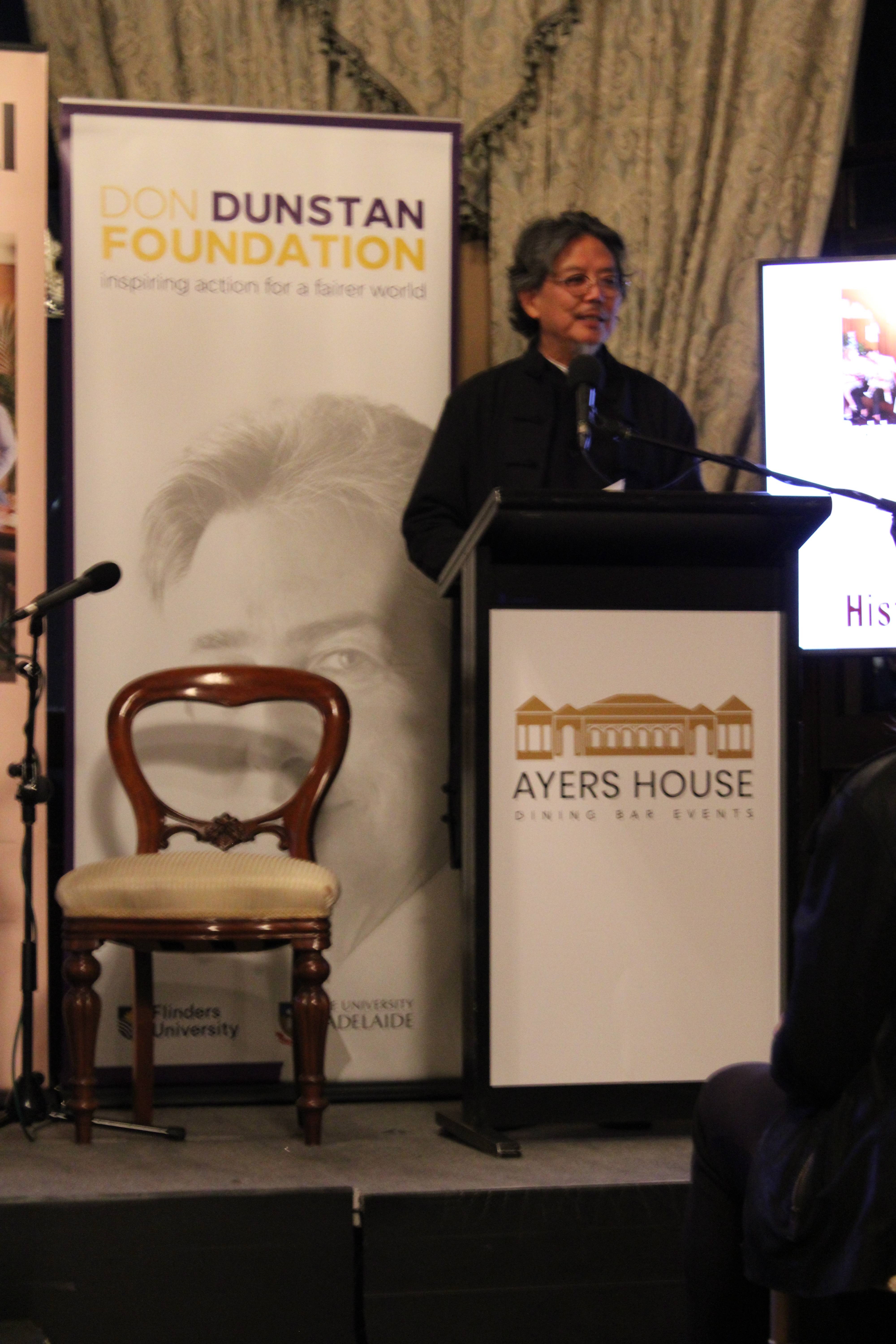
By OOI KEE BENG, speech at Ayer’s House, given as part of the Adelaide’s History Festival, on 12 May 2025
SIBLING RELATIONSHIPS are very complex matters. I come from a family with four brothers, and two half-brothers and a half-sister. And I have three children from two marriages. Much insights—and moments of exasperation—have been gained from that in my life. I am sure that is the case for most people with siblings.
In fact, studying sibling relationships can provide effective analytical and conceptual tools through which members of the family—and also the wider world—can come to understand the psychological, the sociological, the socio-economic and the geopolitical world which impinges on how each sibling perceives the world.
What each sibling struggles with in their lives can differ greatly. They may be twins or they may be half-siblings, but their world will be very different. It is in the differences and similarities between them that the diversity in the human experience and in human ambitions can be saliently mapped.
What this occasion has given me, being invited for a whole week to Adelaide and meeting all sorts of important and wonderful people, and having the opportunity to turn my mind to the past of the two cities of George Town and Adelaide, and indeed to the possible future of their relationship, is to analogize sibling relationships to those of cities which s have commonalities in their historical span, who have been fellow travelers in space and time.
George Town and Adelaide, yes, very clearly. Twinning them as an administrative and diplomatic process was a commendable foresight by Don Dunstan, supported by Chief Minister Lim Chong Eu of Penang. But in my analogical context, I wouldn’t call them twins. Indeed, as Goh Ban Lee extrapolated in his book “The Lights’ Legacy”, the son, William, when given the task of planning Adelaide, was probably reacting to the fact that his spiritual and reputational inheritance of George Town had been taken from him, and that as a new settlement, George Town seemed to have left much more to the personal whims of its first settlers than to any professional planner.
Adelaide, I would venture then for my present purpose, was a much younger brother to George Town, and therefore informed at its founding by a familial wish to rectify mistakes and heal reputational damages. A speculative thought no doubt, but one worth considering. The thing about younger siblings is that they tend to have been born into a recently constructed context. And often, they are better educated. With that, they may be more hampered by social structures but more able to function and flow comfortably within the mainstreams of power, albeit more contained in their imagination.
Thereof, the relative freedom to act which the elder sibling is able to experience. He decides the game. Chaos is more acceptable in what he chooses to do, spontaneous actions are more appropriate in his world, and collaborators are given by fate more than structurally provided.
My first point is to highlight the subsequences following the founding of the two cities. One was a frontier colony with unclear and ad hoc aims. The other was a settler colony coming into being within a much more structured power constellation: the latter makes us more appreciative of William Light’s personal decisions about Adelaide’s founding not being in line with instructions he was given by London. Francis Light had it much easier, and could make planning and economic decisions with little consideration for any home-office boss.
Apart from one Light coming much later after the other, we should consider their creations within the fast-paced geopolitical changes of the late 18th and early 18th century.
At this point, I need to bring in other sibling cities. I have little knowledge of Australian urban history, so I shall not venture into that territory to identify relevant sibling cities. But from what I know, Melbourne, founded just when Adelaide also came into being, had a very different historical and socio-economic trajectory. Compared to Melbourne, Adelaide was very much a planned city. I might even venture that Adelaide was one of the first planned capital cities in the world, and should be considered within such a context today. Melbourne is more like a cousin to Adelaide rather than a sibling, am I right? Maybe not even a first cousin?
There is at least one sibling city to George Town though, which is by force of geopolitical and socio-cultural history, often studied as a counterpoint city; that is of course Singapore. It was founded closer in time to George Town, in 1819, halfway between the founding of George Town and Adelaide, and much closer in geopolitical and geographic space to George Town than Adelaide.
To manifest the difference between Singapore and George Town, I am convinced, will highlight certain traits that will help locate Adelaide in the family history.
Penang was founded in 1786, Singapore in 1819. Shifting our focus to the British Empire now, away from the Light family, the big difference in geopolitical time was that while Penang was founded for tactical reasons, for mercantilist advantages and for elbowing gains, Singapore was something else altogether.
Singapore was founded by a Britain that was a new global power fresh out of victory over Napoleon, and now entertaining realistic dreams about world hegemony—trading and supply chain hegemony if nothing else. In that sense, Singapore was a strategic creation, vis-à-vis other Atlantic European powers and vis-à-vis the crumbling Qing Empire.
The China market was about to be forced open. The opium undermining of the Chinese trade wall was thoroughly underway, ever since the failure of the Macartney expedition in 1793 to Changde (Xanadu) to convince the Qianlong Emperor to allow more trade with the British.
To sharpen my point, Singapore was founded for the building of a trading empire, unlike Penang. Singapore was from Day One, a modern economy, conceived of adult parents with high ambitions. In a recent article published by the Economic Society of Singapore, I portrayed Singapore as an exemplary and extreme example of an Asian city founded upon what we would recognize as Modernity; I argued that Singapore was part and parcel of the Political Economy building of post-Napoleonic Britain. Here was another sibling with a comparatively better planned time of conception, more like Adelaide.
How Penang and Singapore became the Straits Settlements after 1824, together with Malacca (which in my analogous framework I would call an adopted sibling, along with Labuan, Christmas Island, and the Cocos-Keeling Islands), is illustrative of what the parents were up to—, namely control the regional trade routes, keep other European powers at bay, and penetrating and perhaps monopolizing the China Market.
In some ways, the birth of Singapore saw their parents lose interest in their wilder and older child, Penang. Thus, Penang was left to its own devices as a localized capitalist hub and entrepot, while Singapore became an important trainee for, and heir to, the family’s growing business in this part of the world.
The India side of the story, I am sure, is of great interest here too, but I shall leave it for another time. As an aside, at this point, I could mention Ceylon {Sri Lanka], more specifically Colombo, as a half-sibling, where British takeover of the island happened within the tactical moves taken to limit French control in the Far East.
Also, we must not forget Junk Ceylon (namely Phuket), 435 kms north of Penang. Called Thalang by the Siamese, and Salang by the local population (both meaning “Cape”), its full name of “Tanjung Salang”—Tanjung being Malay also for “Cape”, was soon corrupted in Western usage into “Junk Ceylon”. Its present name of “Phuket” today is simply a local pronunciation of the Malay “Bukit”, meaning “Hill”. In fact, in some ways, Phuket is a sibling closest in space, time and interests to Penang.
Phuket was known for its tin deposits, and we do know that William Light’s father spent a lot of his time there—and in Kuala Kedah, a river mouth settlement opposite northern Penang Island—before establishing the colony of Penang for the English East India Company in 1786. In fact, migration from Phuket and Kuala Kedah is assumed to explain the fast growth of Penang’s population in the early years, including an inflow of Catholic Eurasians and French missionaries fleeing the Siamese purge of Christians. This explains the strong influence that Catholic schools came to have in the Anglican enclave of Penang, to this day. In understanding the multicultural harmony, one should in fact not forget the tolerance of the first Anglican government of Penang in accepting French Catholics and Portuguese Eurasian Catholics among the island’s first inhabitants.
One last sibling city to mention perched on this family tree I am drawing, is of course, Hong Kong.
Despite the clear connection between the founding of Penang (1786), Singapore (1819) and Hong Kong (1842) as a historical forward-movement through the Malacca Straits towards Guangzhou and Tianjin, and as part of 19th Century British Global Political Economy Building—my technical term for British colonialism—, one has to say that Hong Kong was conceived of another mother, as it were. While Penang and Singapore came to be populated by a mix of archipelagic peoples, with a strong input of southern Chinese and southern Indian cultural flavours, Hong Kong remained very much a Cantonese stronghold culturally, like its first cousin, Macau.
Due to their importance in trade and finance, Hong Kong and Singapore tend to be studied together today, while Penang and Singapore tend to be considered together more for anthropological reasons. Politically though, or perhaps “Post-colonially”, there are reasons that Penang and Hong Kong be placed together as well. Both soon came to be absorbed into their immediatelysome neighbouring post-colonial countries—Penang in 1957 into the Federation of Malaya, and Hong Kong in 1998 into the People’s Republic of China (albeit with a 50-year incorporation plan, which Penang did not have). Singapore managed to go its own way, freeing itself and finding its own pad as it were, by sticking tightly to the ambitions and rationale of its parents’ global business.
Now, let us distance ourselves a bit from this family history within which cities were either founded or incorporated as part of a fast-evolving global ambition. Resistance to this 100-year Anglicizing of East Asian affairs, has always been there, and much poison remains in the water we drink. There is also much denial of the familial context and origins involved.
The challenge for all of us, as Adelaide nears the celebration of 200 years of illustrious growth, and Penang moves towards its 250th year of recalcitrant existence, is to recognize our family tree, and to revisit how we are connected, and how we are not. Getting to know one’s family is not always an easy affair, especially if the point is to build a lasting and mutually fruitful relationship.
Most importantly, we have to consider how the neighbourhood has changed, how the village has changed, how the global context has changed. Only with that knowledge can we make good of the past, benefit from our family ties, and realise our common ambitions.
Adelaide lies at 35 degrees South, Singapore at 1-degree North, Penang at 5 degrees North, Sri Lanka at around 7 degrees North, Phuket at 8 degrees North, Hong Kong at 22 degrees North. And all located between India and China. This is a diasporic family we are talking about. Underlying the whole approach I have taken today is the understanding that economic growth and planning going forward are very much a matter driven by urban centres, by cities. Of the cities mentioned earlier, some are major urban centres, some are secondary cities. I think we can consider Penang and Adelaide Secondary Cities.
Now, secondary cities, like middle siblings, tend to be creative and socially capable. I believe that much good, especially in trade, education and culture comes out of Secondary Cities. Their heads are better screwed on, and they understand that relationships are built on curiosity, humility and honesty.
In summary, what I wish to highlight is the importance of childhood—of cities in this case.
In forgetting the past, we also forget our early connections to the world. And with that, we limit our present possibilities, and we lose depth in our self-understanding.
Knowing ourselves as we are today is best done through re-cognating and recognizing our past in all its variety.
Thank you for your attention.

 Wikibeng
Discussion
No comments yet.