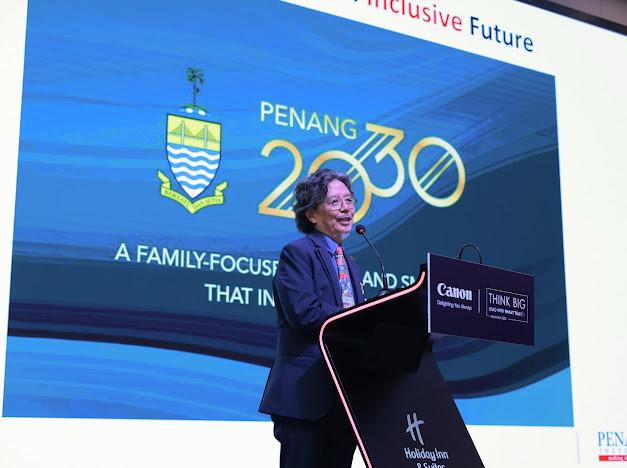
Keynote speech given at Canon Malaysia’s “Think Big” Conference on 9 September 2025 at Holiday Inn, Bukit Mertajam.
PENANG INSTITUTE PROVIDED much of the thinking, the research and the ground support in the creation and socializing of the Penang2030 vision and masterplan, along with Think City and the Chief Minister’s Office. We decided to publicize it as: A Family-focused Smart and Green State that Inspire the Nation.
In other words, we are convinced that semiconductor technology is a key part of our future. At the same time, Penang lives off tourism, not only as a heritage and cultural destination, but also because of the potential for ecotourism in Penang, and because liveability is a vital asset for the wellbeing of the state’s people, and one good reason why people are drawn to Penang. Thus, “Smart and Green”.
In order not to fall into the trap of being too parochial, when Penang2030 was formulated, we also added “that inspires the nation” to the slogan. For those who know Penang, you would know that its people have always been innovative and bold, actually quite recalcitrant, even anarchistic.
Penang as a whole, believes that it can play, and should be allowed to play, a leading role in the modernization, and in the economic and cultural growth of the country. And just as importantly, Penang is a highly globally conscious place, in its economic ties, in its people and their connection to the world, and in the deep understanding of its past, present and future being strongly tied to geopolitical and geo-economic situation in the world.
The “family-focused” bit in the slogan is about inclusivity, and with the family unit as the policy-enabling concept. This is a key concept and that is where the notion of “inclusiveness” is embedded.
Let me start the conversation on inclusiveness from the negative end, that by extension necessarily has strong ideological and moral undertones, and generates strong constraints on policymaking and policy thinking by focusing more on welfare effects rather than developmental results.
Family-focused was the point that Chief Minister Chow Kon Yeow wanted to be central to his vision. In a Western context, the term to use here would have been “individual rights”. What we have been envisaging when we concentrated on “family”, to be clear, is not that we should not consider individual rights.
This is not necessarily a discussion about western versus Asian values. In policy-making in Penang, more effective measures can be imagined if we think of the different types of problems faced by households, than if we think of how individuals can be supported and respected. The former does not ignore the latter. Supporting poor households, people who are physically or otherwise challenged, or people in crisis… that is what we often mean by inclusivieness in Penang.
On that score, Chief Minister Chow has often mentioned how the state should “leave no one behind”. That is a simple and sufficient expression of his political goal.
Limits of Inclusivity
But today, at this very important forum whose ambitions are high and where we are asked to “think big”, when we now envision “an inclusive future” in Penang, let me expand the focus and consider the notion of inclusiveness, how it might sometimes be a limiting concept, and how the sentiments we connect to the term might be wrongly placed.
When we wish to be inclusive in general, there is a danger that we simplify the nature of our population too much, and focus too much on the state as the agent, and on its policies as the way to secure inclusiveness in society.
In some ways, that can’t be helped. That is the nature of democratic politics and public discourses. We identify groups and classify clusters of people who are in manifest need of help; more specifically, when we talk about inclusiveness, we decide the types of help that a government can provide administratively.
But when we wish to be inclusive at the broadest level, our level of ambition for society has to be higher than mere inclusiveness. The question is, when we want to be inclusive, are we trying to enclose society or do we wish to empower society and tolerate differences? Do we seek to regiment society according to certain class and cultural values, or are we seeking to expand space for society’s diversity?
I have lived in quite a few countries for a sizeable length of time, and I notice how a term like “inclusiveness” can often be elitist, a top-down concept instead of a democratic concept. So, let us make some comparisons and see why I think inclusiveness can mean many things, somethings negative, sometimes positive things.
Next slide
SWEDEN
Now, I lived a long time in a welfare state, namely Sweden. Until about 25 years ago, Sweden had a very homogenous population, and its welfare system covered all aspects of life, from cradle to grave. It was a country that seldom talked about ethnicities. Class analysis was the basis for their welfare system and their policies in general. Being inclusive for them meant administrative reliability and minimized arbitrariness in policy application. Fairness in a welfare society also meant state monitoring of citizens, especially in monetary matters.
Today, due to heavy immigration, especially from the Middle East, the country now faces grave issues that they don’t really know how to handle. These problems appear to strike at the core of their welfare system, and may yet lead to social unrest.
Sweden was, and seeks to be, an inclusive society. But it is now having trouble defining what this inclusiveness means. Is inclusiveness as they had understood it a sustainable goal? How far can inclusiveness go? At what point must they begin to exclude more and more of their residents?
One commendable aspect of Swedish society is its policies to promote Gender Equality. But I won’t have time to talk about that today.
We see new measures being taken by the Swedish state today to encourage settled immigrants to leave, including monetary incentives from the state. Inclusiveness has its limits, and its prerequisites. These prerequisites vary depending on what we mean by inclusiveness, by fairness.
When the issue was to bridge the income gap, welfare inclusiveness proved possible if a system was democratic enough, the bureaucracy was clean enough, and society’s range of values was not too broad.
But when one adds deep ethnic differences, great religious divides, and profoundly varied public discourses and values into the equation, then maintaining social and political stability requires new understandings of inclusiveness and new notions of fairness.
Simply put, Swedish society has changed much faster and much more deeply than the system can adapt to. And so, their old rules and processes no longer work very well, and even risks crumbling.
Managing change seems to me to be the greatest challenge faced by even the most successful systems of governance.
SINGAPORE
Let me now take another country to look at. Let’s look at Singapore, where I lived for a sizeable amount of time as well.
When Singapore under the PAP was constructing the Republic of Singapore, they did in fact study the Scandinavian countries to see if these could be a possible format to adopt for the little new island state at the other end of the world.
Fortunately for them, the Singaporean leaders were pragmatic and practical enough to realise that their conditions—both internal and external ones—were too different. Creating a stable governing system was not enough. They needed a social revolution as well, going from colonial outpost to island state would require a mindset change and a total reset in the system of governance. Their main concerns were: (1) The ethnic heterogeneity of its people; (2) the suddenness of its founding and the need to build a strong state; (3) the corruptibility of its people, meaning the need for a mindset change to suit and sustain a modern—almost accidental—nation, and; (4) the lack of a military, and: (5) the need to build a robust national economy as quickly as possible. Lastly, their national discourse had to be clearly distinct from Malaysian discourses on nation building
The top PAP leadership was convinced that it had to maintain political stability while it created a strong economy. The two were connected of course. The emerging apparatus of the state had to be a driver of the economy while maintaining stability. State building and national economy building would occur hand in hand. Nation building, meaning the creation of a Singapore identity, would follow as a necessary medium-term result of the success of the other two.
Inclusiveness was imagined through economic growth and all the institutions that would in an interconnected fashion support that. More importantly, the work ethics of its citizens must not be undermined by a welfare state. Welfare was necessarily in many ways, but it must not be publicised as welfare, but as necessary measures in the creation of a strong state and a strong national economy. The HDB system, backed by an encompassing and expanded CPF system, was also created. The National Service in which all male citizens had to serve, was projected to be an arena for common experience of all male Singaporeans. Owning an HDB would give each citizen a reason to fight for, and to identify with the state-building and national-economy building agenda of the government.
As its economy grew by leaps and bounds, and its political system became more and more stable, Singapore, backed by a strong education system and a closely monitored workforce migration policy, and a closely monitored citizenry, became an economic powerhouse.
Inclusiveness was highly dictated by the state building and the national-economy building processes that the government realized to be necessary for national success, and for national security.
Most importantly, such a model is highly cognizant of geo-economics and geopolitical conditions, and therefore the public discourse and the common purpose of building a strong nation and staying ahead has no end. Nobody gets to rest, ever. Success cannot be maintained unless it keeps striving forward.
Singapore’s challenge today is the income gap, which grows all the more as the country remains the first or second most expensive country in the world. And inclusivity in such a stressful context fosters growing nationalistic sentiments. While the Singapore model, due to the size of the country and its population, relies on importing talents and workers according to separate regulations, tensions between the common Singaporean, at any class level, and resident foreigners is where the notion of inclusivity is tested today.
PENANG
Ethnic plurality is part of the DNA of Penang. Being an island settlement of the English, the economic and political dynamic of the place has been liberal and inclusive. Any wish to keep foreigners or non-Penang people out is rendered irrational, partly by federal dominance of policymaking and governance, and partly because Penang suffers a sustained talent brain drain.
It should be noted that much of Penang’s lifestyle is based partly on a survival mindset vis-à-vis federal political dominance and in cognizant of its small size, and partly on opportunities outside of Penang. All that has to be considered in policy thinking in Penang. When we wish to be inclusive, therefore, the formulation of the state’s vision is less about seeking common purpose or discursive hegemony, than it is about acknowledging the economic dynamism of its people.
This has strong historical reasons: Governance in Penang has always been minimalist, and its economic growth has depended on open borders and the entrepreneurship of its port-based migrant population. The Japanese occupation changed that reality, and that was continued under the Emergency, and then the uncertainties of the Merdeka period and the troubles of the 1960s.
Rising like a phoenix out of the damage wrought by the ending of its free port status, thanks to the industrialization initiatives of Tun Dr Lim Chong Eu and the early management of the Penang Development Corporation (PDC), Penang went from reliance on regional trade and the entrepot economy to a reliance on our industrial free trade zones.
Penang people went from being port workers to factory workers. That has been a blessing in many ways. Its tourism depends on its past as a vibrant port (archipelagic) culture, and its industrial strength is strongly tied to global supply chains.
To talk about inclusiveness in a place with high migration and high social mobility is difficult. Penang is a very open society, economically, demographically and ideologically. It has a resilient and entrepreneurial population.
Recognising Penang’s weak subnational status; recognizing Penang’s comparative advantages such as a generally high level of education among its people and their international connections and knowledge, and taking advantage of a population that is good at making do, that is entrepreneurial, and largely SME-based: those have to be the wisdoms behind policymaking in Penang. Our political model is one that is Facilitative and Adaptive, business-friendly and socially and environmentally conscious. Penang’s strength is its people, and its people’s strength builds on their international consciousness, their relatively high education, and their inter-ethnic adaptability.
Administratively controlled by Putrajaya, economically reliant on international supply chains and MNCs, also means that much of Penang’s administrative and economic dynamics occur in silos. Working in silos means living in silos and thinking in silos, the public sphere becomes segregated and fragmented, and not only due to racial and centralist politics, but due to economic functions and processes. The search for common purpose suffers, and inclusive policies become superficial and focused on short-term effects.
Synergy is much more needed than inclusiveness in Penang today. Organisations whose goal is to seek collaboration at least among industry players is more needed than clubs or narrow lobby groups.
Lastly, I should say a few words about the inclusivity that is vital to such discussions, and that is Gender Equality.
After living for long periods in so many countries, I realise that how I judge a society and a political agenda today is by how they treat their women. Do they empower their young women, or curtail their growth? Does gender equality mean that women should become more like men?
Or should a society be inclusive by simplifying and integrating its people’s ambitions and lifestyles? For example, in gender issues, mere inclusiveness falls far short of the bigger goals of the feminist agenda.
There is always the danger that inclusiveness becomes regimentation—in lifestyles, in values, in ambitions, in social behaviour? For example, one can be inclusive in the army. All are treated equally, but there is little diversity there.
Be that as it may, inclusiveness is a vital goal in Malaysia, largely because we are a society that many decades ago decided to highlight identity as its major political discourse. This in effect suggests exclusivity. And exclusivity tends to undermine the nation-building process quite severely. This process of exclusivity has in fact affected and reversed the natural and organic integration of its many cultures.
This is one reason why so much of Malaysian creativity and productivity happens in silos. There is low trust in our fellow citizens, and there is no sense of common purpose and unity which can inspire us to work as a collective for long-term goals, or to accelerate our productivity in a synergistic way. So, we end up working in silos.
Inclusivity, for all its good points, is a passive term where those who get included are concerned. This is one side of the policymaking equation, politically correct and comprehensible. But inclusivity in a more active form would is empowerment and encouragement, or synergy.
In the end, the search is for solidarity, but one that is sustainable, and therefore conducive to economic growth, political stability, and societal synergy.

 Wikibeng
Discussion
No comments yet.