By Ooi Kee Beng, Penang Monthly Editorial, December 2025
NOTHING PROVIDES MORE inspiration for coinage of terms than our five senses. We fashion fundamental words to describe the wide range of information that flows from without onto our body and brain.
For example, I am told that the sense of Touch relies on our Skin being subjected to the following notions: Pressure, Temperature, Pain (tissue damage), Itch and Vibration.
Sight, in turn, is the naked Human Eye’s response to Light Waves, and we thus have the spectrum of named colours lying between infrared and ultraviolet. We term them primarily as Red, Yellow and Blue, and we appreciate the secondary colours they give rise to as green, orange and purple.
Ears, meanwhile, respond to Vibrations, and this has qualities such as pitch or loudness, or some specific quality in it we often call timbre. Out of these, we have manufactured language and music.
Airborne chemical stimuli affect the Human Nose. Breaking smell stimuli down is quite a difficult task. One good try lists these as: fragrant, woody/resinous, fruity (non-citrus), chemical, minty/peppermint, sweet, popcorn, lemon, pungent and decayed.
Twinning the ability to Smell is the ability to Taste. Tasting is done by the Tongue and its buds, and unlike Smell, some liquid is needed for taste to emanate; our saliva is the default liquid for that. Taste is often broken down into the following notions: Sweet, Salty, Sour, Bitter and Umami (savory).
When it comes to food and our ability to accept and enjoy it or to reject and discard it, humans actually rely on both Tongue and Nose to decide. Thus, airborne chemicals and dissolved chemicals come together to afford vital information for deciding whether some mouthful is good nourishment and offers enjoyment, or whether it is poison and should be avoided.
Then comes the subjective input. As similar beings, why is it that different humans—not to mention different societies—prefer starkly different dishes? But although taste preferences vary a lot, there are more or less tastes within communities that are common enough to identify them as a collective.
Obviously, there is such a thing as getting used to things. Once you or your community get familiarised to some taste, some colour, some smell, you build up not only a nostalgic bond to it, you also identify with it. Your group adopts it as an identity marker, and you build a discourse around it, to include some and to exclude others. Sustained stimuli inspire sciences and songs, and even prose and poetry to afford them a special cultural status. Once just a notion, they become denotations and carry integral meaning for a group.
Just as a deep bond between two persons builds on common experiences retold as common memory, communities rely on common cultural rituals and learned discourses to perpetuate their supposed uniqueness.
Our senses play a most central role in that very fundamental process of generating a sense of belonging and common purpose. Over time, a group picks certain colours and patterns to define it. In fact, one could wonder if a group can be said to exist at all before such decisions had evolved. They may favour the look of this dress or that pattern to weave togetherness with. Then, they may prefer certain sounds to define them too. From that appear favoured musical rhythms, popular songs and common language.
Where the sense of smell is concerned, I am sure the mating game is inspired by which odour, which stench, which fume is most attracting to the opposite sex.
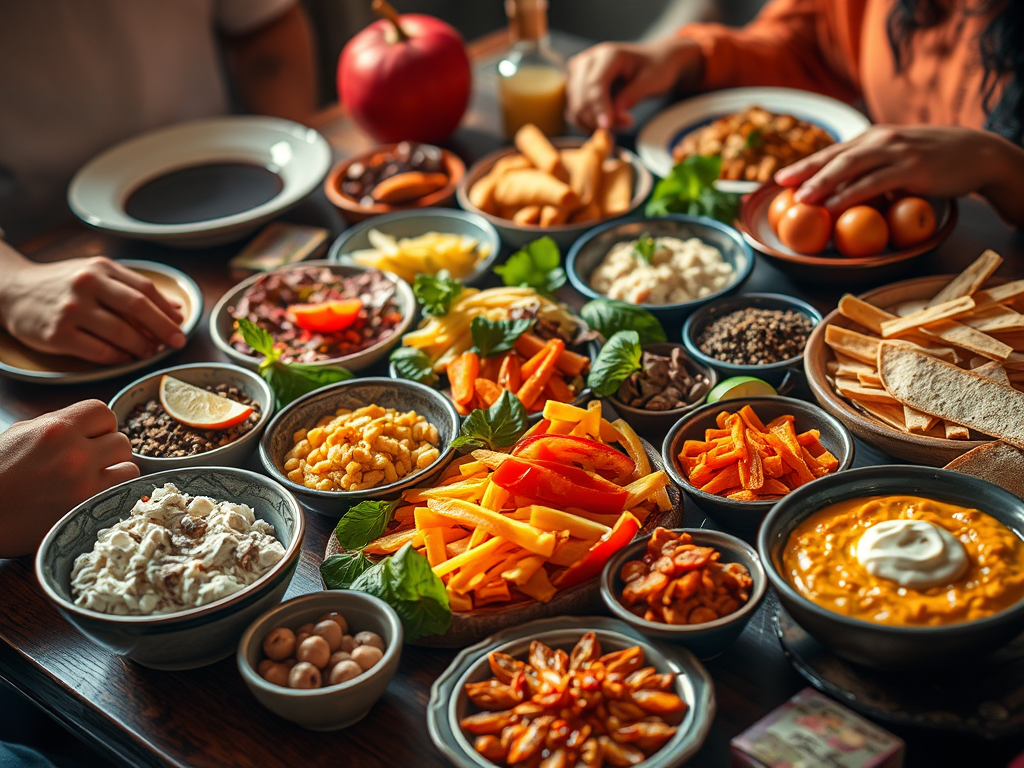
But then, food and drink—or more specifically, the preparation, provision and consuming of food and drink—may be the elements that take the place of honour in generating a sense of common culture, common resolve and common humanity. Imbibing food and drink happens all day, as a rule, and therefore, these cannot but be the most prominent pillars of identity.
Food as identity marker is not something to be taken lightly. When you take away the food of my people, you take away my cultural identity. When I defend my culture, I defend what food I eat. This is more immediate a cultural experience than my flag or my music.
It is second only to language, to my need to use the language I am most familiar with. My mother tongue and my mother’s milk appear to be the most intimate connections we have to the world.
I would end with the caveat that we bite, eat and imbibe most gratifyingly not only with our smell and tastes, but with all senses simultaneously, along with whatever experiential biases we have picked up along the way. How would we otherwise explain that tastes are acquired and acquirable, and that food dishes also suffer fashion trends, and rise and fall in popularity?

 Wikibeng
Discussion
No comments yet.