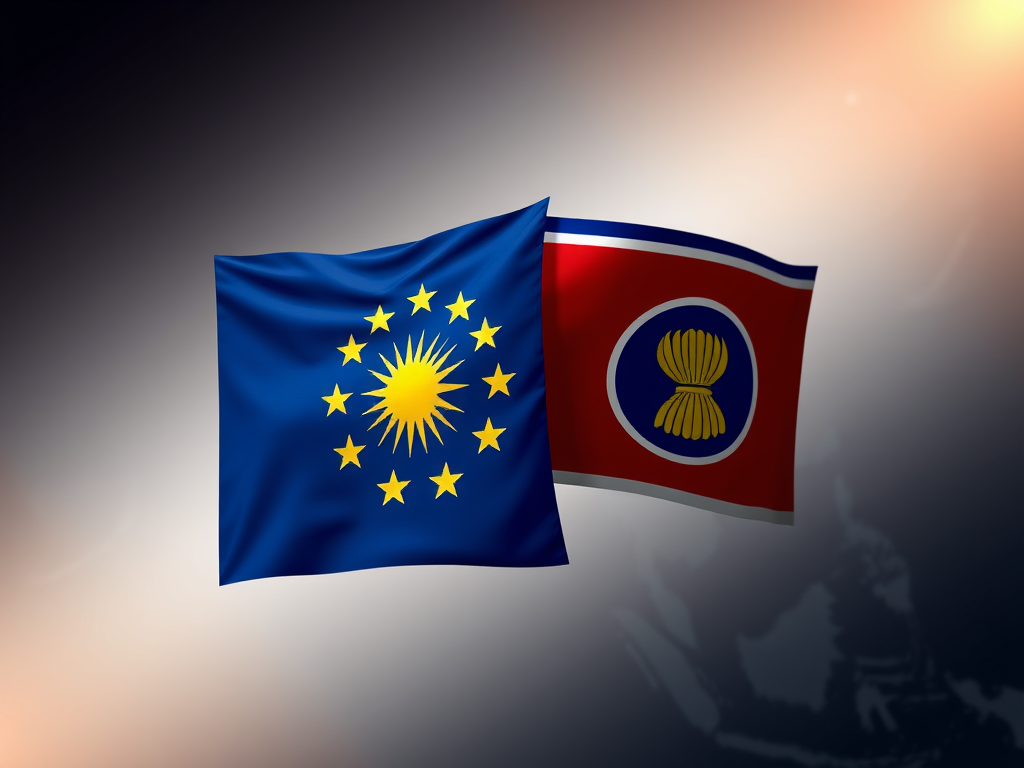
By Ooi Kee Beng, This article first appeared in Forum, The Edge Malaysia Weekly on January 26, 2026 – February 1, 2026, under the column “Picking on the Present”.
Tensions have increased for European countries between their role as members of the Cold War military organisation Nato, and their long-term ambitions to become a super-state through the European Union (EU). This became most pointedly clear after US President Donald Trump expressed a troubling persistence in his wish to take over Denmark’s autonomous region of Greenland.
Since the EU is the foremost exponent of regionalism in the world, it appears cogent to restate comparisons between that organisation, and our own regional architecture, Asean. With the advent of multipolarity, Europe’s geopolitical status as a middle power — and strategical buffer between Russia and the US — is becoming obvious, a position not unlike Asean’s, where the art of balancing between big powers has been honed since the 1960s.
The question to ask, going forward, is how regionalism — a path meant to remedy the ills of nationalism on one side and global hegemony on the other — can structure multipolarity and minimise global tensions and conflicts.
Both Asean and the EU are constructs meant to be adaptive to changing geopolitical situations, albeit that the former has been more pragmatic in its modus operandi than the latter. Both have however been concerned mainly with the twin issues of: (i) regional economic growth; and (ii) regional security. While the EU had its origins in the aftermath of World War II, and Asean appeared only in 1967, they were nevertheless both configured by Cold War conditions.
Considered as a period of post-colonial restructuring, we can gainfully perceive that one is a reflection of the other: The colonial powers were largely destroyed and the rebuilding process had to be a regional undertaking — thus the European Economic Community (EEC) was founded. At the other end of the colonial chain were countries emerging from the dust of colonialism seeking to establish themselves in the midst of the Cold War — thus Asean came into being, and in the cautious fashion that still characterises it.
In both cases, regionalism seemed a necessary way forward for maintaining national sovereignty and influencing international affairs.
As the bipolar world of the Cold War shifted to become somewhat “unipolar” in the 1990s, both these regional organisations adapted opportunistically. For Asean, the 1990s allowed for its expansion towards including all countries within Southeast Asia. For the EU, a similar process occurred; but some would point out that it expanded across Europe too quickly and too idealistically. Because of its overlap with Nato, strategical concerns always loomed in the background.
Asean had focused on security in the early decades, shifted to economic development and integration only after the Cold War ended. It then nurtured its influence under the unipolar order by being an effective convener of summits and proponent of multilateralism.
As the world moves towards multipolarity, the EU and Asean — significant economic and security poles in themselves — have new challenges to face, new opportunities to embrace, and new geopolitical and geo-economic mindsets to adopt.
Nationalism — often considered the primordial emotion that tests the patience and undermines the ambitions of regionalists all over the world — is on the rise in European countries. In Asean, however, that passion is more readily and morally embraced by its member states. This has given the EU reason to slow its process of integration. (Brexit was of course a great disruption.)
Embracing humility
Given its rather limited ambitions, Asean would view the EU as merely going through a humbling reality check. It was too much in a hurry, it was too ideological rather than pragmatic, and its understanding of its global influence was exaggerated.
Going forward, such established regional bodies have a key role to play in tempering the path of confrontation and zero sum thinking that big powers are prone to adopt. Instead of just looking at the EU and Asean as regionalist projects, we should now perceive them within the context of emergent multipolarity, with all its possibilities and all its dangers.
Both the EU and Asean’s passion for regional integration has been infected, limited and transformed in the last decade by big-power tensions. Asean, for example, can no longer pretend it is in the driver’s seat of its own progress, as it did a decade or two ago.
Nor can the EU, in the wake of Trumpian trade tariffs and strategic realism.
While each Asean member state has always realised the need to balance between the big powers, that predicament — or possibility — seems less obvious among EU countries.
Whichever the case, both the EU and Asean now stand out as regionalist entities rather than as big powers in a multipolar world. As multilateral creations, they are in a good position to sustain international trade and promote cross-border cooperation, each on their side of the world.
Midwifing the future
They are both well placed to assist in midwifing into being a collaborative world where open international trade can temper the more self-serving paths that unitary economic poles are prone to take.
However, the historical, philosophical (more than ideological) and developmental differences are significant between them.
But what has been encouraging in recent decades, is that after all the killings and the conquests, the subjugation and the enslavement of the modern era of human history, we seem to have caught on to the idea today that multilateral — not only mutual, but multilateral — economic interests is the key to peace and prosperity. Global economic multipolarity has to be taken seriously; and regionalism, existing within that order, holds the potential and the moral agency to steer that evolution towards general prosperity for all nations.

 Wikibeng
Discussion
No comments yet.