By OOI KEE BENG, Feature in Penang Monthly, March 2026.
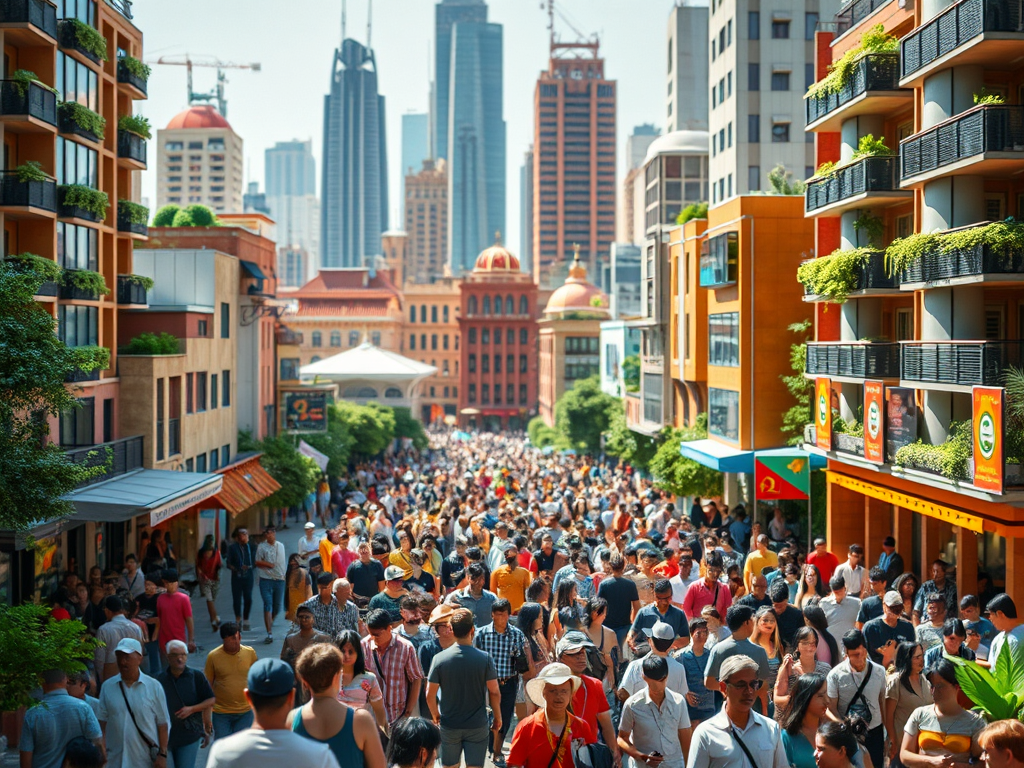
COSMOPOLIS. That is an exciting word that is full of positive connotations. The original Greek expresses this idea by pairing Kosmos (“world” or “universe”) with Polis (“city-state”). Cosmopolis thus translates into “world-city”, which in short signifies the ideal of a unified political com-munity that absorbs and accepts—and in the process, minimises conflicts between—the multitude of nations, ethnicities and tribes. A global order is imagined that is inclusive, and within which every human is a citizen. This coherent whole, however, is an urban one. We cannot but conceive of cosmopolitan centres as places that are maddingly crowded, ethnically diverse and culturally fluid.
If we now shift to the Indian civilisational sphere, we find that there are at least two terms in Sanskrit that approximately express the spirit of the abovementioned thought. One is “Vasudhaiva Kutumbakan”, an ethical term suggesting the unity of all creation; the other is “Chakravala Chakra-vartin”, the universal sovereign who rules the dvipas, i.e. the world’s constituent continents.
Chinese political thought, in turn, owns the term Tianxia, often translated as “All under Heaven” and denotes the known world, or more probably, the imperial polity as a whole. The Indian and Chinese ideas, however, do not assume the world to be made up of cities; they are more indicative of territorial overview. The Greek Cosmopolis clearly imagines crowded cities exhibiting a matured world civilisation and globally inclusive order.
Today, that word is seldom used in daily conversation (except increasingly and interestingly in political philosophy debates pronouncing the overshadowed enlightenment thoughts of 15th-century Europe to counteract the dominance of those of the 16th-century which scholars today are conversant in). The former (exemplified by Montaigne and Shakespeake) champion the spontaneous and the human, the latter (fronted by Descartes and Newton) the mechanical and the precise.
A COCKTAIL OF VARIATIONS
Cosmopolitan and Cosmopolitanism are today the semantic variations of the word commonly encountered in serious dis-courses. Besides denoting a cocktail, a cosmopolitan used as a noun literally means “a citizen of the world”. But it appears most popularly as an adjective: a cosmopolitan person is an open-minded and global-ly-savvy sophisticate, expectantly free of provincial biases; a cosmopolitan place is an economically and socially dynamic city strongly flavoured in multicultural interac-tions; and a cosmopolitan idea is worldwide in scope and universally relevant.
Notably, describing something as cosmopolitan falls short of the high ideals contained in the doctrine of Cosmopolitanism. At the same time, that long word flaps like a rallying pennant in the wind, voicing the conviction that all human beings belong to a globe-spanning single community. It heralds the attitude that our primary obligation is to humanity as a whole.
But something is not quite right. The Cosmopolis, despite its basic declaration of love for cultural diversity nevertheless seeks conformity in values in the long run. There is something in the concept that is highly reminiscent of monotheism; it seeks final unity in rationality. It may celebrate diversity and difference, but it loves political stability and moral conformity more. It lacks faith in the positive power of conflict and arguments. It strives for harmony in variance, but distrusts opposition and disorder.
A ROOM OF ONE’S OWN, EVEN FOR COSMOPOLISES
This brings me to the main reason for writing this article. I wish to introduce the word Cosmopolises. If we are to love difference in human societies, we should not envision that differences can find space within that singularity we call the cosmopolis. We should instead imagine enough room for differences within a unifying cosmopolis to not lead to suppression, and for enough space so that a loose cosmopolis need not predicate inevitable collapse.
In my time, I have lived in more than one city that warrant being called cosmopolitan. It has taught me that the cosmopolitan character of each of these relies on dynamics—their compromises are different, their cultural interactions are different, and the diversity of their values, in the end, are different.
Yet, while we should call each of them a cosmopolis, we should not exaggerate them to be examples of the same, or similar, phenomenon. Cosmopolis as a word is given to being much more connotative than denotative.
Thus, the need for Cosmopolises. That is the pluralised form favoured by Penang Institute and Penang Monthly to front the George Town Literary Festival (GTLF) in 2026. That semantic form injects inclusiveness into the term Cosmopolis itself, and thus leaves the latter without an end goal.
The word Cosmopolis, in the singular, given time and unpredictable changes, risks becoming a paradox. To avoid that situation from building up over time, we need to pluralise the concept.
Every cosmopolis consists of its own set of differences and tensions. Every mix of cultures, every venue for intercourse between human cultures, is different; every mix of economic dynamics is unique. And these sets of differences should not—and cannot—be reduced into a few tight abstractions to become comfortably comparable.
When I was in Istanbul some time ago, it struck me how the cosmopolitan character of that wonderful city was hugely different from, say, London. Even Penang’s cosmopolitan nature is clearly different from that of her erstwhile twin, Singapore.
Then there is Shanghai and how it differs as a cosmopolis from Beijing. One is prone to think of each of these cities as being less cosmopolitan than the aforementioned ones in the Middle East, Europe and Southeast Asia. That, I believe, is largely due to the outsider not being able to recognise differences in the population. Despite the fact that the population in these giant Chinese cities stem from centuries of cultural inflows and outflows from diverse places across the empire and beyond, patient time and continual hybridity have smoothened the edges of differences, at least to a visiting outsider.
Interestingly, such cases support the point I wish to make about cosmopolises. Older cosmopolitan centres have been melting pots for a long time, and original differences are naturally faded. Hybridity now passes for homogeneity, and to a significant degree.
The Cosmopolis suggests a trajectory that is to lead to Global Cosmopolitanism, but taking that ideal path will litter it with righteous suppression of differences. Each cosmopolis is different, and each has its own tensions, and they cannot co-exist comfortably if brought together too closely politically and ideologically, or if each is misrepresented as being more or less true to the ideal of Cosmopolitanism.
Cosmopolises allow for time to take its course, for differences to work themselves out according to each their own dynamic and nature. But to rank these differences within some unspoken and emotive ideal of evolutionary unity and commonality of values, and to not appreciate the different existential trajectories they find them-selves in, amounts to singular cosmopolitan hegemony.
*OOI KEE BENG is an accidental hybrid product of the many Cosmopolises he has had the fortune to reside within.

 Wikibeng
Discussion
No comments yet.