By Ooi Kee Beng, Editorial for October 2023 in Penang Monthly
MODERN ECONOMICS and modern living are paradoxically based on sustained advances in means of mobility, on the one hand, and in the human ability to live in huge settlements, on the other.
Bringing human individuals into close proximity with each other in regular and systemic ways without conflict requires two things to happen at the same time. There must be worthy reasons for them to do so, and there must be easy means for them to congregate and then disperse whenever they wish to.
Firstly, where worthy reasons are concerned, the decisive change in human self-understanding in modern times is the advent of “economics”—the habit of considering inter-personnel relations and mutual benefits in terms of transactions in one sense or another. Summarily, that may be seen as a fundamental, worthy reason for humans to bother with each other despite cultural differences and value gaps.
The rise of urban centres is often, in effect, the collective expression of the wish over time for tighter and more dynamic economic activities and benefits. As people settle close to each other, a collective identity develops over time. More or less common experiences lead to more or less common ways of discussing those experiences.
Controlled Chaos and Traffic Jams
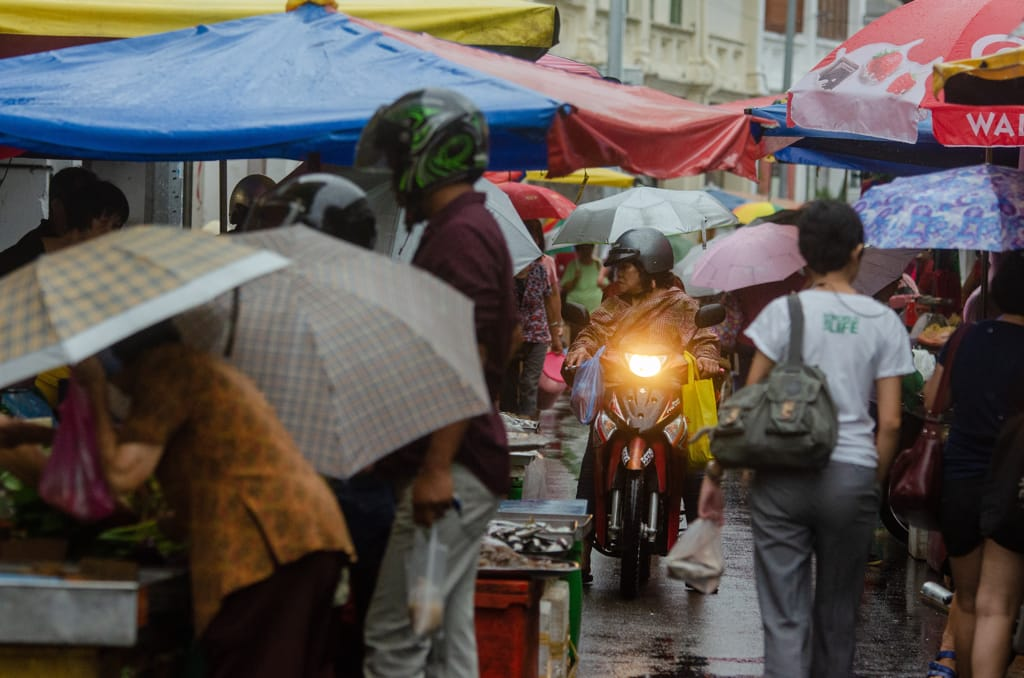
Economic exchanges are aided by reliability and predictability, and so, regulations and rules come into play. Police, lawyers and judges grow in numbers, filling gigantic halls and buildings not accessible to the common man. Some gain more than others in this conglomeration of people; and so, one could announce the urban centre as being, in essence, a site of controlled chaos where people gàn huó (干活), i.e. make a living—bargaining and making economic choices all day long.
Cities tend to grow, and as they grow and their parts diversify in economic functions—and even in identity and culture—public transport becomes important. The diverse parts need to meet to facilitate their economic functions, and the more they meet, the more efficiently these exchanges can occur.
Therewith, we come secondly to urban human mobility and the strategic importance of public transport.
Nowhere is the aforementioned controlled chaos that is modern city life more evident on a daily basis than in the traffic bottlenecks of a city during rush hour. The time squandered and the aggravation generated in traffic jams carry economic costs, of course; immediately as in lost activities, and secondarily through their detrimental effects on the city’s liveability standards.
Easy Mobility and Common Purpose
Observing the cities that I have lived in over the last few decades, I could not help noticing how much their inhabitants relate to their urban environment depends on how mobile the city’s transport infrastructure allows them to be.
If a city has a spiderweb kind of transport infrastructure, then the sense is that most things happen at the centre, and the outer fringes offer only approximations of what are on offer at the centre. You get a suburban feel that grows as you leave the centre, until fresher air tells you that you are in the countryside. That’s the basic idea of how a city is built.
Dublin is certainly built that way. Stockholm too. The city centres of such smaller cities are served by networks of buses or underground rails, and streets are often designed to assist the pedestrian, be this child, adult or the disabled. Parks and gardens dot the city centre as well. Accessibility to public services and commercial centres requires that their street designs minimise the conflict between car and pedestrian.
Buses and rails radiate out of the centre of these cities in all directions, facilitating people mobility, transporting goods to and fro—and transmitting a needed sense of common purpose and connectedness among commuters, whose days are a mix of city and countryside living.
In the case of an island-state like Singapore, its urbanisation radiates from the south end of the island, and over time, has left behind hardly any area that one can call rural. Instead, their town planners visualise a “Garden City”, and a “City in a Garden”. Despite its impressively developed and affordable public transport system, it remains a highly walkable city punctuated by gardens and parks. Ease of departure from the city is provided by the stupendous Changi Airport.
Hong Kong is famous for its public transport, and although its intra-city connectedness is not as easy for the pedestrian as is the case in Singapore, the idea is that the pedestrian—or the worker or consumer if you like—can get away to anywhere he or she wishes by public transport. Hong Kong’s connectedness to the rest of the world is facilitated by its wonderful airport, the high-speed rail to Shenzhen and Guangzhou, and the Hong Kong-Zhuhai-Macau Bridge.
What about mega-cities like London, or Beijing, or Shanghai? Well, the good thing about old cities is that many parts are full of small streets that necessarily limit car flows. Pedestrians can still recognise that the city had evolved into being around the daily activities of people like them.
These cities do not have just one centre. Thus, their public transport system has had to be intricately planned and developed. London is, of course, also famous for its many enormous parks and gardens. Beijing’s open spaces—ancient and modern—are also of world renown.
What about Penang? Given the comments occasioned by thoughts about other cities, on the status of the pedestrian in the mind of city planners, the availability of gardens and parks, public transport options, the connectedness within and out of the city, et cetera, we should consider what Penang’s controlled chaos is like, and how we can reorganise it.
We should ask ourselves the following as comparative long-term questions: How walkable is Penang’s city centre? Are its streets safe for child, adult and the disabled? How connected are its many parts? How can its public transport be improved, even in the short term? The car being king, does that mean that the sense of common purpose among Penang’s inhabitants is being weakened? Are our parks worth visiting, and are there enough of them?
Loving Penang is necessarily dependent on loving easy access to its many luxuries.


 Wikibeng
Insightful exploration of urban mobility! The emphasis on accessibility, public transport, and city connectivity offers a thoughtful urban planning vision.
Posted by vividkreations | March 12, 2025, 4:05 pmThx. Yes, I think we need an ideology called Pedestrianism
Posted by Ooi Kee Beng | June 25, 2025, 12:58 pm