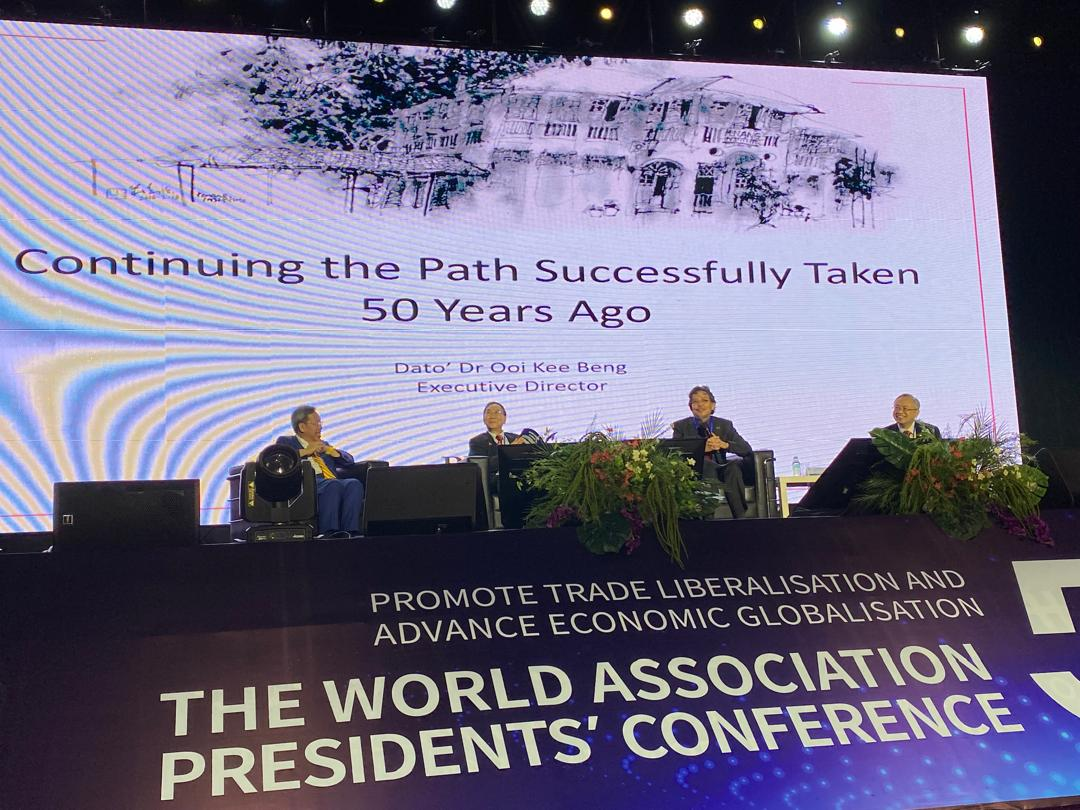
By Ooi Kee Beng, speech given at the opening forum titled “Pioneering the New Frontier: Technological Innovation, Economic Transformation”, of the 5th World Association Presidents’ Conference (WAPC) held on 2 December 2024 at Wisma MCA, Kuala Lumpur.
We can study the New Frontiers confronting us today either from a geopolitical level, or we can do it from below instead, meaning from a more provincial or even local level. If we do the latter, then the Malaysian state of Penang is a good illustrative and illuminative case. These new conditions are not necessarily new, and Penang, as a small state and a small city had responded most effectively to it in the 1970s, the effects of which are what now provide Penang and Malaysia with the means to manage the new challenges facing the country and the region 50 years later.
In the decade after independence, during which Malaysia experienced great changes (race riots, Malaysia was formed and brought the Indonesian confrontation into being, and then Singapore left the newly expanded federation), Penang’s economy went into crisis, with unemployment there reaching 8% in 1970, with youth unemployment being at least double as high.
What happened in the 1970s and 1980s was the gigantic project launched under Tun Dr Lim Chong Eu’s watch to industrialise Penang, and by extension Malaysia as well. Today, the industrial sector in Penang has not only become one of the major engines for Malaysian economic growth, but its development into a powerful global E&E manufacturing centre; this includes the semiconductor sector that has now caught worldwide attention, given the US-China trade war.
It is in times of crisis that it becomes clear what one has done well, and what one has not done well. The importance of the semiconductor sector or the E&E sector shows that Penang’s entrepreneurs and its people have indeed invested in the right places. Their participation in the global manufacturing market over decades led to the organic growth of a manufacturing ecosystem that now leaves Malaysia with a competitive advantage in Southeast Asia instead. It is mature, it is diverse, it runs deep and broad, and it is highly connected to the global supply chains.
The political, health and economic crises that hit the country in 2020 saw Penang hitting the ground running. At the same time, the country’s poor development also became obvious. This was; in education, mainly where education standards and employability are concerned and in the low interest in STEM subjects that had become the norm; in developmental policies which had ignored the building of infrastructure to support the growth of the country’s strongest industries in the right places; and in health matters, Malaysians now appearing to be a rather sickly population with high obesity and middle-age sicknesses.
Where foreign relations are concerned, Malaysia has often played the field, promoting neutrality and non-partisanship as far as possible. By and large, the country has no enemies, and it is seen as a champion of international trade.
Going forward, enhancing these strengths and remedying these weaknesses hold great promise for the country to exert greater influence in international technological trade and innovations, and keeping the geopolitical climate in the region peaceful and as multilateral as possible.
Today, in facing new challenges at the local, the national or the global level, the same qualities are required of the people themselves. Back then, the population of Penang went from being port workers to being factory workers, in simple terms. As Tun Lim Chong Eu said in 1971, “if we can revive the morale of the people, we would have gone a long way to solving the ills of the state”.
The situation is much better today, the window of opportunity will not stay open for long. There is too much adjusting happening among too many countries for Penang and Malaysia to retain its advantage and to rely on its present place in the supply chain.
For Penang, the questions being raised are related to the following:
- How can the federal government help? Finally, a proper long-term plan for national industrial development is very much needed. So far, the New Industrial Master Plan and the National Semiconductor Strategy have been announced, albeit with some haste. But will the implementation of this plan be too centrally-conceived or does it consider the industrial strengths on the ground?
- How do we secure a flow of engineers and other technically educated young Malaysians, and do that with a view towards upgrading the industrial sector as a whole?
- How can the semiconductor industry and the E&E sector take advantage of the strong ecosystem in order to branch into adjacent fields, and into computer electronics, into household item production, into IoT, and into agritech.
- How can we expand our market and our production to serve the Global South sustainably, away from overreliance on outsourced production?
- How to arrange a system for financing in support of these new entrepreneurs in Malaysia?
- Rapid development of the logistical and infrastructural support is urgently needed to grow the northern states to handle the higher capacity of imports and exports.
- How can we improve our infrastructural services and support for the tourism sector from airport amenities and services to hospitality services, at the same time? Taking advantage of this advantageous period should involve other segments of Penang’s and the country’s economy. In Penang, this would be tourism, the services sector, the medical sector, etc.

 Wikibeng
A great piece..especially Chong Eu Role..it was a joy to be his private Secretary doring those pioneering year. I introduce him to the word that was first starting to swirl in futures thinking : THE TECHNOTRONIC AGE. Sorry I missed your launch ..getting better and starting to normalise.. Every best
Anwa
Posted by multiversityinternational | December 3, 2024, 9:00 pm