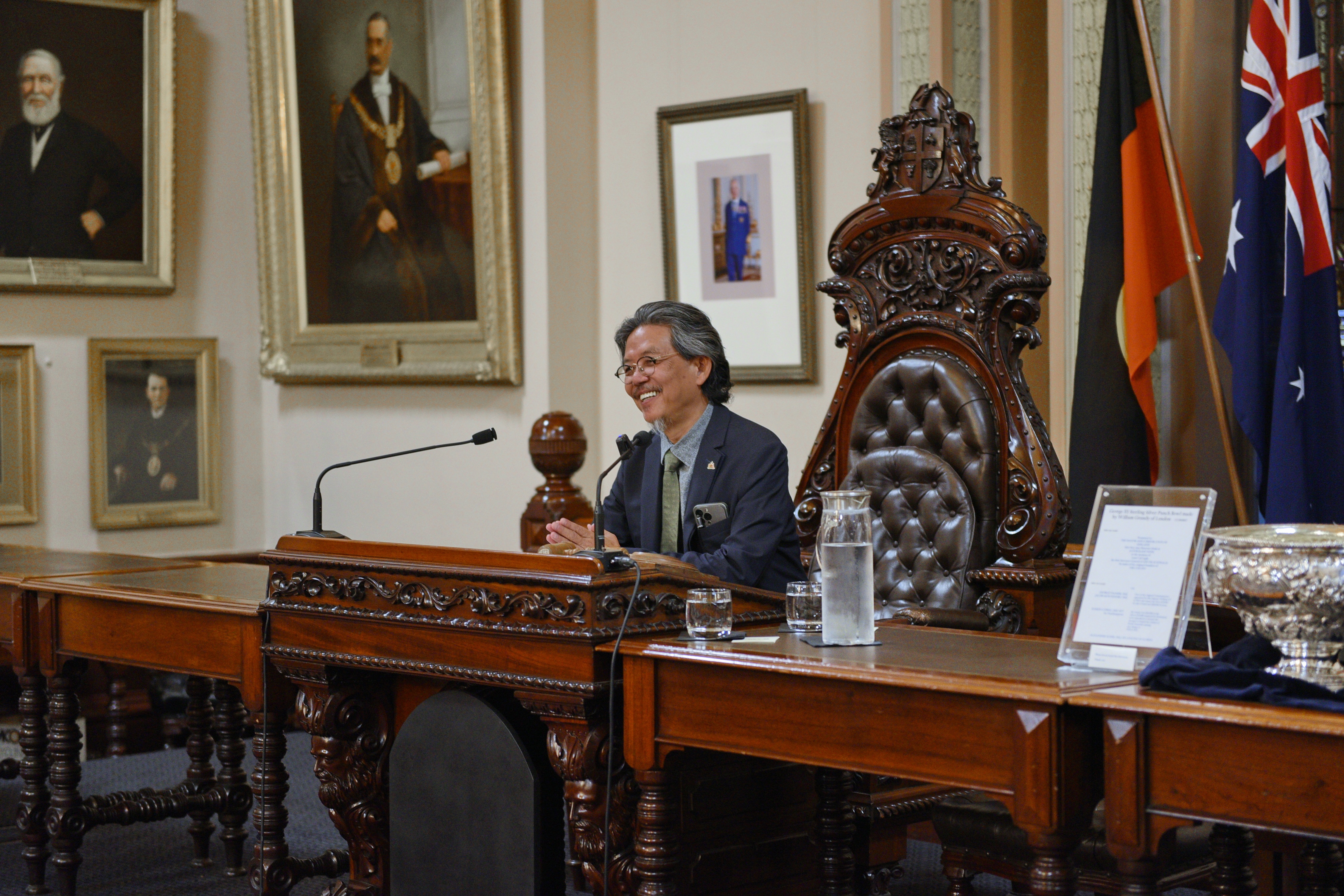
- Speaking at the Colonel Light Celebrations, 9 May 2025, at Adelaide Town Hall at the special invitation of the Lord Mayor of Adelaide, Dr Jane Lomax-Smith.
By Dr OOI KEE BENG
My being here today, in Adelaide, South Australia, is still a great surprise to me. This is because there are certain geographical journeys in one’s step-by-step trip through life that one does not envisage for a variety of reasons. Australia was never on my to-see and to-do list.
I lived in Sweden most of my adult life, after leaving Penang in my early 20s. Then I lived in Singapore for 14 years before returning home to Penang about a decade ago. My intellectual life was strongly formatted by my interests in (1) Journalism, meaning for me the phenomenon of communication and messaging; (2) History, because we are all born without stories and therefore need orientating narratives to perform within and find meaning in; (3) Philosophy, because words are such wonderful yet treacherous tools, leading us as much as they confuse us; and (4) Politics, which in my world and line of work is best understood as Geopolitics.
My fifth disciplinary interest, to complete the picture is actually Sinology, the study of Chinese culture. But I shall not dwell on that today.
But as you may agree, the most gratifying journeys are exactly of the kind you did not plan according to your life schedule and your intellectual streams of thought. These tend to shake you up the most philosophically, and the impressions from such trips tend to be memorable because they stay with you the longest.
I am most thankful to Lord Mayor Dr Jane Lomax-Smith and her staff, and to the Don Dunston Foundation for inviting me to Adelaide, and for making me feel so much at home in this wonderful city. The Lord Mayor’s wish to seek out ways for collaboration and discussion, pulling on the thread connecting Adelaide and George Town, is for me, an inspiring one. And that is why I am here today. Optimism is inspiring, optimism is stimulating.
Geopolitical History
I wish to focus on two things today. One is Geopolitical History.
Global consciousness and confusion was visited repeatedly upon Humanity over the last few centuries, and Humanity has found it difficult to live at peace with its own diversity. It is a self-discovery Humanity has not managed very well.
I define Globalisation as the period which Humanity has been going through since inter-continental travel began; it has been a period when we humans have been confronted with, and have tried to come to terms with, our diversity and our ignorance of ourselves and of Mother Nature. Hopefully, we are entering an Age of Mature Globalisation now, during which we realise that mutual respect (coded by economists as “sustainability”) in our actions towards Nature, towards other peoples, and towards other individuals is the best way forward for gaining holistic knowledge, generating civilisation depth, and cultivating humility.
Humanist Education
This brings me to the second idea after Geopolitical History that I wish to focus on today, and that is Humanist Education.
Before modern globalisation, civilisations knew of each other in a distant manner, each introverted unto itself, obsessed with its own discourses and ambitions. What defines modernity is the shrinking of distance between different civilizations and cultures; this has painfully tested the human ability to be humble and humane, tolerant and curious. It has also shown us how far we can go in being cruel and greedy towards other humans, and to be ignorant and arrogant to human events outside our horizons of understanding.
Also, when I say Humanist Education, I am not accepting the validity of the line drawn between the Social Sciences and the Humanities. I find it hard to consider the wisdoms of these disciplines separately.
My love of History comes from my love of Philosophy, both Western and Chinese; from understanding my world within a currently salient geopolitical structure and legacy, and finally, from the wish to communicate, knowing that I am most creative and original—and hopefully most interesting—when I am seeking to communicate.
I remember the deep epiphany I experienced when I first went into the Social Sciences. This was at Stockholm University. Sociology and Psychology offered me novel ways of perceiving the world. I even found Public Administration (my first degree) to be eye-opening, even if boring. I then discovered Philosophy, and found certain Philosophers such as Benedict Spinoza and Ludwig Wittgenstein, and many of the Existentialists, to be awesome and inspiring in how they showed that knowledge is most relevant if gained through a critical mind-set, and not only from what one is told.
I often advise my children, and my younger colleagues, to try to identify the historical forces at play whenever they think of exploring any particular subject at all. These forces are hard to see because their time spans are so different from that of an individual being; we need a telescope, or a microscope as the case may be, to see them.
An individual has to understand how global human agency has continuously been exerted power over the world, and continues to do so; and how events have shaped the world he was born into and how he or she is to think about that world. Critical thinking has to be about identifying such paths in the individual’s life, and of their continued salience.
What are we caught in? What are we drowning in? What is the nature of the forces acting upon us? Are they invisible?
What hand did Fate deal you? Deal your family, your people? Your nation?
Understanding oneself without understanding what currents one is caught in is surely a vain position to assume.
Being born in 1955 in Penang is different from if I were to have been born forty years later.
What class, what gender, what race, what religion were you born into? The answers to these provides the framework for your eventual acculturation. Further down the road, knowing the encompassing tapestry of geopolitical time and ideological space over one’s times provides salient material for the reading of one’s Fate.
I do not wish to play down the importance of individuality and individual traits, but what I wish to highlight is the overwhelming saliency of Geopolitics, Geo-economics, and Geo-technology.
In simpler times, we used the term Colonialism to explain global exercise of power and of economic connectivity. While that term is not really useable today, we do have to deal with the colonial legacy and all its contradictions and paradoxes today.
In a country like Malaysia, Nationalism was always a very positive word. Nationalists were patriots, they were anti-colonialists, they were protectors of the poor and needy. Imagine my surprise when I first went to live in Europe, to discover that Nationalism was practically a dirty word. That was an eye-opener to me as a young man living in a foreign continent.
Thereafter, reading about “nation-building” to me always felt a bit limiting, misleading and disingenuous. Certain geopolitical historical paths had led to the evolution of polities that soon became “nation-states”; so should not these larger paths, and how they had continued to develop, be central to nation-building considerations?
Indeed, how the United Nations is constructed is illustrative of the contingent nature of internationalism, and the unresolved problem of global hegemonism. We have the peer group of nations grouped as the UN General Assembly on the one hand, and on the other, we have the firsts among equals in the Security Council.
The contingent nature of that solution, to my mind, is further revealed in how most countries implement in name or in fact, federal delegation of power within their national boundaries.
On top of that, we rely on Regionalism. We have bilateral and multilateral agreements to mitigate the unsuitability of national centralism. We are a hugely dissected world, a rather unflattering snapshot of Humanity trying to come to terms with itself.
Lines are drawn across the globe: boundaries, spheres of influence, national divisions, intra-national divisions, ad nauseum. There seems no way for us to reject this fragile and defensive posturing in human affairs.
Subsidiarity and Mutual Aid
To what extent these were drawn from above and how the bottom had resisted this exercise of global power, be it geopolitical, geo-economic or geo-ideological, is a key concern in my line of thinking. It has led me to the conclusion that power, compromise and resistance from the middle is vital in the equation. Not just top versus bottom and vice versa.
Thus, while nationalism has had salience in the anti-colonial context, federalist attitudes have had to be absorbed as well for things to work. If we imagine that human organisation is necessarily multi-tiered, then multi-polarity is simply a federalist conclusion applied at the global level. International regionalism softens the centralising and homogenising needs of Nationalism, and domestic federalism is an administrative, technocratic and cultural necessity.
Therein lies the logic for Subsidiarity, the notion that things are best done at the lowest level competent enough to deal with them. There is a need to highlight this way of thinking: Governance as largely a multi-tiered and technocratic matter, informed by principles of efficacy and equality; Leadership as the steering and the envisioning towards achieving these technocratic goals; foreign affairs as an exercise in mutual aid and mutual respect.
To my mind, what we should wish for the world today, is for it to have some time to reorganise itself into a system of multipolar spheres, (1) backed by principles of national sovereignty encapsulated in the United Nations project; (2) built on multilateralism in trade; and (3) conscious of multi-tiered administration in any polity, be this within and beyond countries.
Cities as Productive Hubs
At this point, it is also important to think of the Urbanity of Globality. Cities and their environments have become the wealth-generating units. Going forward, the focus has to be on cities as the Atom in the physics of political subsidiarity, techno-economic innovation, and global cultural development.
So it buoys my spirits greatly to be here today, to be invited here by the Lord Mayor of Adelaide to imbibe what I can of your wonderful city, and to gain inspiration from the difference between where I now live, and where you live. I shall not exaggerate the commonalities that exist between the two cities. We cannot live on past similarities; instead we should work towards future convergence in interests, in values and in relations.
It is uplifting for me to see Adelaide show interest in George Town. Seeking productive connections between countries, between cities, and between individuals is the way to go. It’s a no-brainer, really. But no-brainers need champions.
To connect to my point about Humanist Education, you need people with a humanely idealistic and optimistic mind to take the lead, and to generate the healthy and humanist discourses that we will require the more we go into the world of AI, Robotics and Algorithms.
Penang’s Problems and Possibilities
Now, in Penang and Malaysia, we are fighting an uphill battle in many ways. Firstly, our education has been compromised for decades. As with most new nations, the Social Sciences and the Humanities were side-lined and diluted into irrelevance. We are still living with the consequences of that; literacy in the country is locked into discussions about race, religion and royalty. The reform government that is running the country today, for all its weaknesses, is actually an attempt to limit the damage wrought by overzealous Malay ethno-nationalism. Correcting the situation from within is no easy undertaking.
To break the thinking moulded by persistent ethno-nationalism, I believe that Geopolitical History—and the possible futures that subject can offer, is a necessary path to take. Putting Penang in the World, contextualising Penang in geopolitical history and in contemporary strategic concerns, becomes a vital path to explore. The sister city structure Penang has can be used in this context to internationalise Penang’s self-image.
Another asset is the federalist structure Malaysia already has, which offers paths towards greater subsidiarity in the governing of the various states. There is the interest to connect at lower levels, at secondary city level, at think tank levels, at NGO levels.
The idea of subsidiarity, of localisation, of regional supply chains, of knowing thy closest neighbours, or getting to know distant relatives, are becoming relevant, and are much needed.
Such sentiments have great implications for how top-level geopolitics are played out, even in the short term. Would Canada’s anger with the USA, EU disappointment with the USA, and rising interest in SE Asia, encourage Australia to rethink its place in the world, and see Asian societies as trendsetters? But really, being in the Asian neighbourhood, being in the Indian Ocean, Australia’s role in the coming geopolitical map is of great interest to people in SE Asia.
We have to generate discourses aimed at consolidating the winnings of the process of Globalisation at the more regional geopolitical level. These can include:
- Stronger economic democracy through fiscal and other forms of devolution
- Connecting cities as centres of economic growth, knowledge hubs, and cultural vibrancy.
- Inter-civilizational bridges
- Multiculturalism as the given basis for modern society. Mobility is as much the Modern Condition as Urbanity, be this through its enhancement of mobility of people, goods, and capital—- and contraband.
- Environmental balance and food security.
These to me are the challenges of the 21st century. How shall the Humanist mind thrive?
To sum up, the concepts to develop in the near future, are:
- Multipolarity
- Multilateralism
- Multiculturalism
- Subsidiarity
- Sustainability
- Regionalism and Federalism
- Humanist Education
Thank you for your attention, everyone. I look forward to learning from you on what I have been talking about.

 Wikibeng
We should get you a chair like this
Posted by multiversityinternational | May 30, 2025, 6:33 pm