Interview with Yicai Global, July 15, 2026
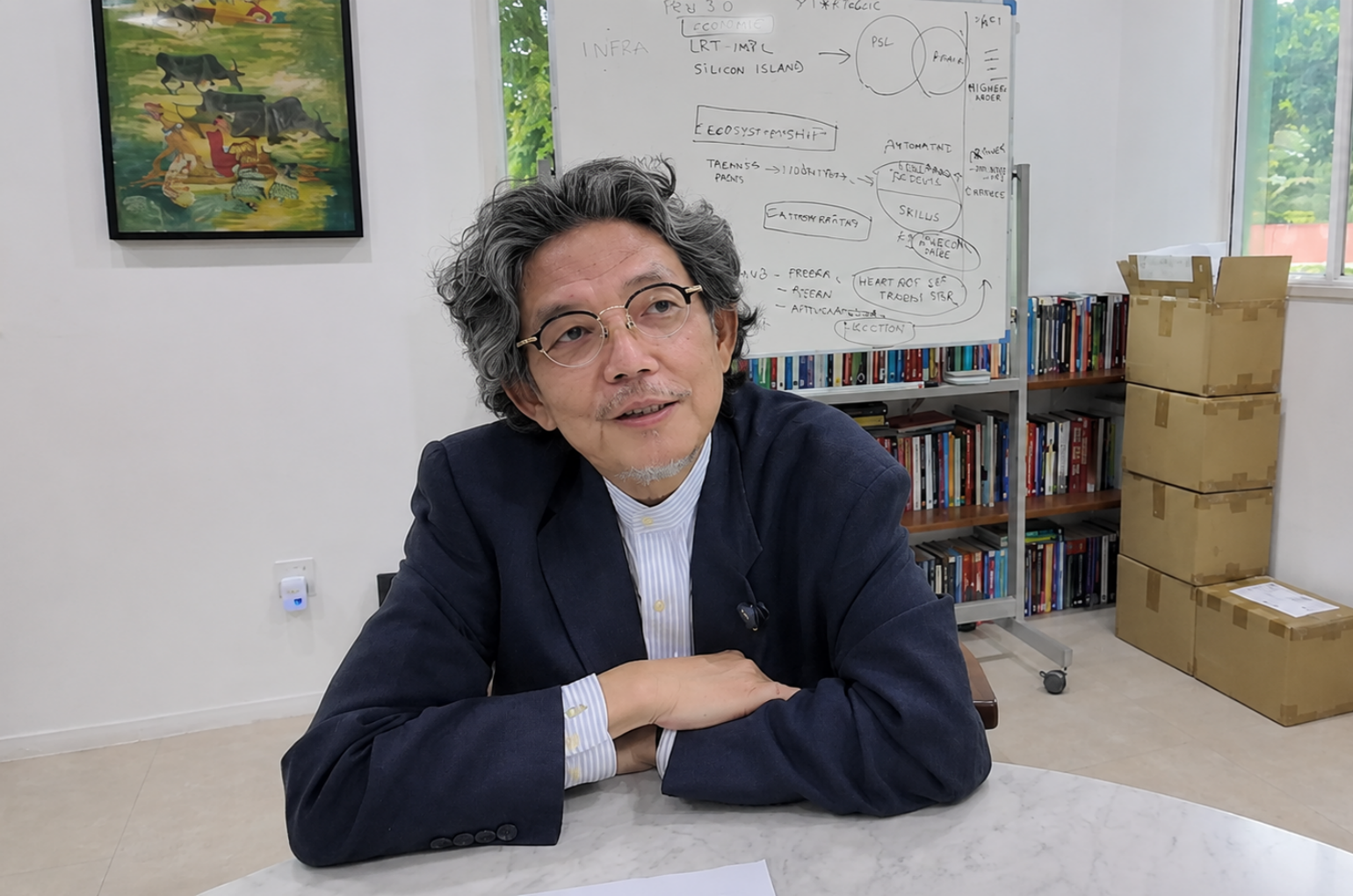
(Yicai) July 15 – A new stage in the decolonization in Southeast Asia began recently, triggered not by politics but by the transformative regional growth driven by China’s phenomenal rise, according to the executive director of Penang Institute, one of Malaysia’s major public policy think tanks.
“The broad shift in global economic productivity to East Asia has redrawn supply chains into a tight network in the region,” Dr Ooi Kee Beng said in a recent interview with Yicai. Dr Ooi has been actively analysing Malaysian and Southeast Asian nation building for several decades, and has been interested in the points of contact between China and Southeast Asia, historically and contemporarily.
Born in Penang in 1955, he studied and worked for 26 years in Sweden, and even translated Sunzi’s The Art of War into Swedish, lectured on Chinese History and Philosophy, and even represented Sweden at the First World Wushu Championship in Beijing in 1991.
He moved to Singapore in 2004 to carry out research at ISEAS – Yusof Ishak Institute, becoming its deputy director from 2011 until he moved back to his home town of Penang in 2017 to run its think tank, Penang Institute.
The sudden tremendous influx of capital from a growing neighbouring big power should not be seen so much as a threat to be managed as a tidal force exposing how little the region was ever truly its own master even after colonialism, according to Ooi. The biggest misconception outsiders have about modern Southeast Asia after the world war, or during the Cold War, has been that it is a coherent geopolitical region. The region is better understood as one that is defined from without rather than from within by some centripetal force. The historical fact is that the region was very much cut into bits in recent centuries, and its economic and socio-economic connections from pre-colonial times were badly broken.
Although archipelagic, the region had more significant ties between islands and between coastlines and between East and Southeast Asia in pre-colonial times than in the postcolonial era.
In the new era of nation states and with national borders imitating colonial borders, people in the region did not really travel much between these new countries. Their modern orientation continued to veer towards their respective colonial metropolises. Only with budget airlines since 2009 and with ASEAN’s open skies initiative were ordinary Southeast Asians able to get to know each other’s countries more seriously through cheap and constant flights.
Ooi pointed out: “We began getting to know each other again only quite recently, at the people level.”
What knitted the region together traditionally, however, was not so much identity as commerce, Ooi stressed. “As a rule, I think that when you can’t trade, you take to piracy,” he added, framing trade as the natural alternative to predation and also suggesting this to be a worldwide phenomenon. “The American conflicts involving Venezuela or Iran in recent months appear very much like acts of piracy to me, concerning oil, among other things,” he stated.
Real cross-cultural interactions occur at street level: “If I sit down with you for a meal and eat your food, I begin to feel that I know you,” he said, adding that China’s visa-free policy for several Southeast Asian nations is wonderful for regional socialisation. “You don’t have to do much. Let people mix, and they will get to know each other and learn about each other.”
Penang as “half-step” for China’s businessmen
For smaller businessmen from China, Penang offers a way to venture overseas without fully leaving home; it is a “half step” into the world, he noted. Arriving on a short flight from home, Chinese entrepreneurs find that their language is spoken here, and that they can adapt quickly to Penang, and that Penang people are rather welcoming. Also, they continue to have easy access to networks back home, he added.
Having a society with deep traits of hybridity stemming from Chinese, English, Indian, Arabic and Malay traditions has given Penang an unusually inclusive culture, one that does not feel it has an indigenous core to defend to the death, according to Ooi.
But as is the case with all places, there are insufficiencies, he said. For example, Penang is short on water and power, making it an unlikely host for energy-hungry AI data centers, he noted, adding that those are likely to be built on mainland Malaysia. No doubt, Penang-based companies will be involved in the emerging data center ecosystem, mainly as suppliers of certain necessities and expertise. Penang’s main strength, he feels, remains in entrepreneurship, engineering and equipment development.
“Penang’s slower and narrower development as a small yet cosmopolitan place proves to be an asset today. Being a latecomer in many fields yet a pathfinder in others, it has the capacity to grow fast, and the knowhow to make full use of new opportunities on offer.”
Supply Chains as Real Currency of Power
However, the deeper competition is not over factories, but over supply chains, Ooi stressed. “Global power is built on control over supply chains,” covering not just goods but payment systems, education and information, among many other areas of production and consumption, he said.
Global dominance has rested on controlling these flows of value, says Ooi, who has separately described that point in a written elaboration as a Western-built system spanning “the petrodollar, the weapons industry, the aviation industry, the knowledge industry, the information industry, you name it.” The speed of China’s recent rise has loosened the West’s grip in several key areas, in EVs and rare earths, for example.
That is why Ooi resists the popular framing of present geopolitical changes as a simple handover of dominance from Washington to Beijing.
“When the dominant power stumbles, everything begins unravelling,” he said. Europe is undergoing a profound psychological adjustment, not merely a political one, having long assumed an autonomy and superiority that the Donald Trump era has exposed to be conditional and time-sensitive, he added.
The shift points not towards a new global hegemon, but toward genuine plurality, Ooi pointed out. “Multipolarity becomes obvious” once the air clears, he said, noting that the world has in fact always been multipolar. Only in the language of hegemony is one able to imagine otherwise.
The forces that can fill the space which is being vacated by the global hegemon are more regional in character rather than global, with new supply chains becoming “more mutually beneficial and where unbalanced advantages can be noted and mitigated through negotiations between governments as respected partners.”
Where the Southeast Asian region is concerned, the Regional Comprehensive Economic Partnership (RCEP) is “the ultimate achievement of ASEAN where peace through trade is concerned,” Ooi stated. Economic collaboration and integration holds the most promise for minimizing conflicts in the world.
Regionalizing Nationalism
The real decolonization of Southeast Asia is only beginning. Each former colony may have won independence, but each stays strongly wired to its old metropole, such as Indonesia to the Dutch, and Malaysia and Singapore to London. These newly independent countries are barely comfortable in each other’s presence, ASEAN or not, Ooi noted. It is the recent rise of a regional great power that finally forces them to consider why they have been relating so weakly to their immediate neighbours and so strongly to their former masters, he said.
He claimed that there is a necessity to “regionalize nationalism—in the region and anywhere else.”
Smaller countries on the Belt and Road need to be more proactive within a historical understanding of their own situation and to act accordingly, and not just wait passively for bigger powers like Beijing to design everything from the top down with its own interests in mind, he said.
What he calls “Little BRIs” can feature smaller countries getting together, cognizant of giant regional-spanning projects being planned, to develop on their own terms their input and participation in them. This is clearly a possibility where continental speedy rail systems are concerned. Other areas would include maritime logistics, merchant shipping, and security links where the region’s own states could exercise more control.
Countries that keep thinking of themselves as small and passive—as victims of history and of size—risk locking themselves into staying that way, Ooi claimed.
The view from Penang, in the end, is not about choosing between China and the United States but about how regional discourses are formulated for accepting differences rather than ranking them, Ooi stressed. The global economic and political wave reshaping the region’s factories and ports, and its worries and hopes, is less a tsunami than a long-postponed invitation to a conversation the region writ large has never quite had with itself, he said.


Discussion
No comments yet.