By Ooi Kee Beng, Editorial for September 2026 issue of Penang Monthly .
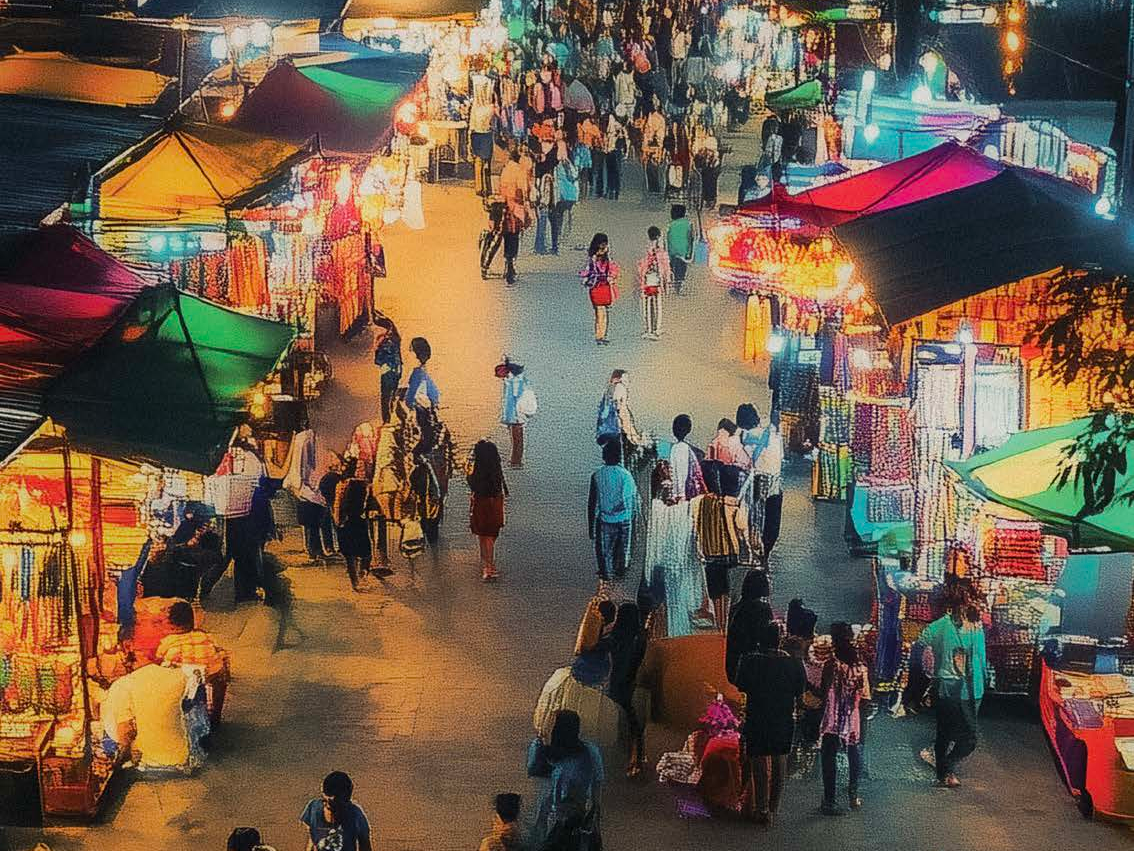
THE POLITICAL ECONOMY encompassing the night market is strangely illuminative of human society. Why do I say that?
Now, one can take the individual as the point of departure for analysing the bare constituents of society. Or one can start with the family, quickly scaling upwards to the clan, and so on.
The former approach leads to a Lockean individual giving up certain rights and freedoms, having realised that the resultant collective and polity bring more substantial gains than the retention of individual rights alone. The latter, on the other hand, is based on familial bonds, which require negotiations, agreements and intermarriages between different identities—whether based on surnames, clans or villages—for coexistence.
In either case, a political centre has to emerge. In general terms, how the nature of this centre is justified and extrapolated upon distinguishes the Western adoration for the Individual from the Confucian esteem for the Family. This difference is a much dis-cussed and debated matter which remains unsolved and unresolved.
This month’s focus on the night market (or “pasar malam” in Malay) inspires me to take an alternative point of departure for understanding human bonds—and bondage—across bloodlines, before the state emerged to absorb basic economic activities as the basis for its raison d’être.
RATIONALISING TIME AND SPACE
To simplify matters somewhat, let us liken the urban pasar malam in settings like Penang to a river-mouth Sunday market from a rural past, where barter trade was the order of the day. From one tributary come boats bearing succulent fruits from the high slopes of neighbouring hills. From another, sampans carry carcases of pigs, deer and birds of all sizes. From further down the coast women arrive, carrying bundles of newly harvested crops. Fishing boats from the delta bring fresh catches of sea creatures, great and small.
Issues of space and time need to be immediately managed. When and where should they all congregate as sellers and buyers? What language should they speak? All this would gradually evolve into common agreement through regular practice and convenience. And it would be determined in various ways, be it through threats and coercion, or give-and-take and mutual self-interest.
More concretely, which group should take which spot on the beach, and how much space can they claim for the day? If this market is a one-off matter, then some aggressive elbowing might suffice, a first-come-first-served model could work or perhaps the bigger group with the most muscular men would decide.
However, if it is to be a regular event, the message has to be passed around to as many groups in the vicinity as possible: foot-fall is vital for a market to sustain the supply of and demand for a variety of goods. These hopeful and geographically diverse barter businesses would have to deal with all these matters, further com-plicated if their mother tongues are not commonly understandable. Thus, some order has to be maintained and routinised.
Herewith, Economics meets Politics, and Political Economy is born. Political power comes into being: first through the need to facilitate the transfer of goods, and by extension to stimulate production for future market days. The management of space and time—and perhaps language use in signage or the formulation of general rules—is soon necessary.
Protection is needed as well. You do not want pirates raid-ing these gatherings. Perhaps a fortress can be built around the market grounds, with recognisable armed forces watching out for disruptive behaviour. No disturbing of the peace, please: no theft, no violence.
Above all, a common currency is needed to ease trading. Call it protection money if you like, but for barter to become more efficient and predictable, taxes and fees have to be imposed. The mobility of this money—and its value—will subsequently have to be controlled as well. That is now the fuel for the political economy.
And thus, the State is born.
This apparatus outwardly seeks to oversee all of society and regulate economic behaviour for the “common good”. It quickly evolves into an administration which is now not only responsible for deciding upon a common language but also monopolising violence. These are the prerequisites for trade and the imposition of formal laws. The state does not only manage time and space, however; it has to control understandings of time and space. An ideology is necessarily developed that gives collective meaning to the community, be this in religious or economic terms.
CONTROLLING THE CONTROLLING STATE
Now comes the imperative to control the controllers. Limiting the powerful, while the powerful control schools, messaging, transfers of wealth and taxation cannot be an easy task. Whatever the form of this powerful entity, whether the Leviathan or the Son of Heaven (or the Kerajaan, in the regional context), the challenge remains crucial today.
The western historical trajectory came up with democracy, a mechanism through which power can be, if not controlled, at least disrupted by some time-limiting process. But according to Aristotle and others, this system has inbuilt and inevitable weaknesses—namely populism, in most cases—that will destroy it in the end.
Meanwhile, the Confucian tradition constructs the notion of Tianming (the mandate of heaven), which claims that the job of the powerful is merely to bring prosperity and wellbeing to the people. But if the sovereign does not carry out this duty properly—a problem exacerbated by the lack of institutional checks and balances apart from the protests of righteous mandarins—then the consequences can be dire. Whether through popular uprising as proposed by the Confucian philosopher Mencius, or Heavenly intervention as per Zhou Dynasty discourse, regime change is justified if that duty has been neglected by the state.
In our times, when territory-fixated nation-states and national economic growth determine political discourses and international relations, a consciousness of key dynamics—i.e., how economics and politics interact; how power is constructed and exercised within a country or globally; and how unresolved human challenges now seriously affect the sustaining dynamics of nature itself—is needed to guide humanity towards a form of global governance which is not self-destructive and exclusive.
To my mind then, the times call for governments to shift away from national interests and essentially parochial policy thinking towards the sustainable management of a globalised world. Global governance is necessarily the key subject for political and philosophical discussion in our era, the underlying ethos for which has to be universal humanism. Otherwise, more forms of genocides and cultural suppression await.


Discussion
No comments yet.