By OOI KEE BENG for “Picking on the Present” in The Edge Malaysia, 22-29 May 2026
About 20 years ago, I had the pleasure of having dinner at the home of Robert Kuok and his wife Poh Lin. It was memorable for many reasons, but not least for something he said which stuck with me for a long time, mainly because I found it intriguing but not quite comprehensible. At least not then.
This lovely man, incidentally Malaysia’s richest person, said to me that evening that he did not hold high opinions about economists: “Economics is simply people living their lives.”
Since then, much water has flowed under the bridge of my mind. I am beginning to understand what that line means now. In recent months, I have been wondering how economics looked like under a feudal system. How does one describe a pre-modern economy?
This led me to consider how political power would take advantage of unprotected masses of people and their wealth. Piracy and theft, and threats and extortion would have played a big role in the creation of a polity. A productive society falls under the mercy of what we would easily recognize as an extortion racket. The wealth produced by that society is “taxed”. “Rent” is taken, in kind or in cash. Fees for services are created which were not needed before the racketeers turned up. The crime of corruption remains an oxymoron.
The quantum of that tax or rent would be enormous. Large enough to create sultans and kings. This makes these sovereigns richer than any single taxed personality under his “rule”.
As with extortion rackets, these leaders offer protection for the original producers of wealth, namely the people in their daily life—from the leaders themselves.
This is not a stable construction, however. And if kept at that level, the system is simply a despotic one, vulgarly based on violence and extortion. How is it to become legitimate, institutionalized, taken for granted? How is it to become “scalable”. This is when rituals and protocols, laws and regulations, religion and ideology, come into play. Through this, terms like “national interests”, “general will”, and even “social contract” a la Rousseau gain substantive meaning, and discursive relevance.
Legitimising Power
Politics now sits as jailor and protector over Economics, the latter as understood in Kuok’s statement. But the political power does not need to remain merely parasite and self-serving. It actually has the means to facilitate the wealth-creating ability of society as a whole. It can organize, it can plan, it can coerce, it can facilitate wealth creation.
It can create Economics as a field of knowledge with the help of which it can predict and strategize. It can draw up budgets, build infrastructures to aid trade, manage excess wealth, build a military to protect, not so much “the people” as, “the economy”, and to ensure its survival and growth.
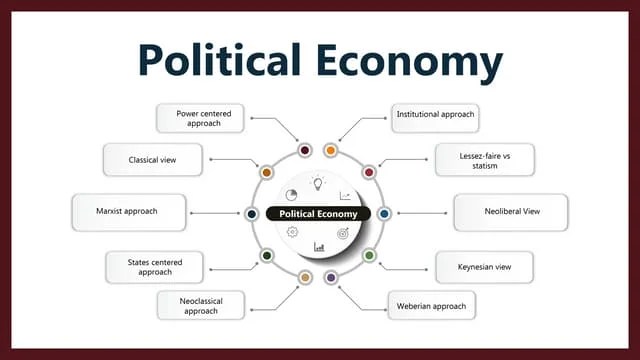
Herewith appears Political Economy. The interplay between the powerful who collect taxes and the productive who get taxed and pay rent becomes so symbiotic that they can now act together for “the general good”. This is often against some other Political Economy.
Adam Smith’s 1776 book on The Wealth of Nations, comes at a certain point in this process. One interpretation of that book is that it sought to limit despotism—either exercised by empires and emperors, or by mercantilists and pirates. Should Politics be transformed to be about facilitating and stimulating the productivity of society, managing redistribution of resources and opportunities, ascertaining internal security, defending the polity against outside threats, then something hugely positive can come out of this human history of coercion and exploitation.
Smith’s book also came in the midst of European colonialism, just before it would peak in the 1800s in the form of the British Maritime Empire. The Political Economy of European Empires and the religions and ideologies developed to stabilize them could not recognize the polities outside Europe as acceptable polities. Not even China.
This allowed for the exclusivity of European progress. What the coming of independence to the former colonies after WWII allowed for was a chance for these new nation states to build their own Political Economy, to wield the resultant power as well as they could within the global economic system managed by the West.
Conceptual Barriers
The remaining question to answer is: Do these new governments understand sufficiently what historical process they are caught up in? How much of their understanding of economics, of power, of “the people”, of Politics, of Economics are still outdated. Is the notion of Political Economy as a source of global agency and socio-cultural development comprehended well enough to be used effectively.
Or do rent-seeking habits and cronyism, along with casteism and feudal attitudes of governance still pervade society. In short, one has to ask of every state whether it has evolved enough to act as the champion of societal freedom, growth and progress vis-a-vis other countries, other politico-economies, or is it recognizably and essentially still an extortionist racket?
Can we learn to see this conceptual struggle happening in Southeast Asian countries? Why lies Malaysia? Singapore? Comparisons between the history of the political discourses since independence would be most informative.
That difficult process of going from a society where Politics and Economics are still separate to one where the two have come to terms with each other and have realised the need to work as a unit, a Political Economy, is what I would call Nation Building. Come to think of it, I have in other contexts quite correctly named this National-economy Building.
In the end, the creators of wealth are the people, through their daily achievements and creativity. They are the source of productivity. The state’s job is to help them, not limit them for its own sake. The state cannot be separate from them and their wellbeing. That seems a workable definition of Democracy to my ears.


I love the graphic.
Keep up the grest work. Anwar
Posted by multiversityinternational | May 26, 2026, 6:30 pm