By OOI KEE BENG, in Penang Monthly November 2026
FOR WORKAHOLICS TO drop everything and go on a retreat is as crazy as asking a parent to stop worrying about their children for a while. Not really possible. Unless, of course, the workaholic is suffering the symptoms typical of advanced alcoholism. When he begins doubting his very ability to work well or care well for his family, then he has to take some drastic action. Otherwise, he is at risk of burning out.
Going “cold turkey” for a workaholic … what would that be like? This sounds way too drastic. What about a halfway house then? A resort spa? A mountain retreat? I am of course talking about myself. My workload and involvement in all my interests were overwhelming me in early 2026. I could not continue at the pace I was moving at. Come to think of it, I no longer remembered weekends. My week was made up only of weekdays. I needed a break, and a stint at Rimbun Dahan, not far from Kuala Lumpur, offered a welcome opportunity.
A CHANGE IN PACE
After leaving Sweden in 2004 to work in Singapore, my working life changed from a sporadic mode—when I was a part-time lecturer at Stockholm University and a full-time quality controller at Ericsson Electronics—into an intensive one, as a researcher at the Institute of Southeast Asian Studies (ISEAS). By the time I left to take over Penang Institute, I had written the equivalent of two dozen books in 13 years. During that time, I had also established the policy brief series, ISEAS Perspective, for ISEAS, and the city magazine, Penang Monthly, for Penang Institute.
And with my dear wife, I was raising two young kids. What all this tells me is that in this day and age, late-middle age is not too late in life. It can, in fact, be one’s most productive period. One can peak late. All the better for that, in fact.
Ten years into managing and developing the think tank in my hometown, my interest in work stayed high, but I sensed that I was close to burnout. Something had to be done. But cold turkey was not for me.
Penang Monthly colleagues suggested that I go for an artist’s retreat. They knew of a place called Rimbun Dahan, run by the family of Hijjas Kasturi, the famous architect, which operates an annual Southeast Asian Arts Residency programme. This is sited on Malay Reserve Land in Kuang, near Sungai Buloh, northwest of Kuala Lumpur.
Loving my work, I wished for a halfway house more than a complete retreat from said work. Could that be arranged? Furthermore, would Hijjas’s family agree to consider a writer of opinion pieces and political biographies, not to mention a long-term think-tanker, as an artist in residence?
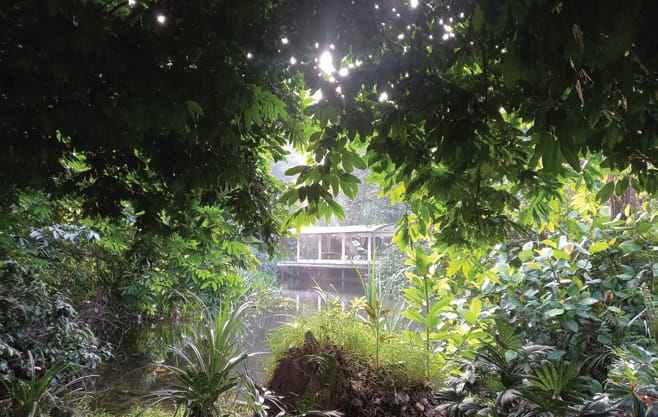
Lush greenery in the morning light (Source: William Tham). Happily, I had met the family before; they knew of my work and my writings, and were happy to have me over for six weeks in June and July. They were even fine with me coming and going, since some of my duties could not be abandoned. So that was arranged, and off I went to Rimbun Dahan.
A JUNGLE IN THE CITY
I entered its compound on the afternoon of 4 June, a Thursday. After going through the gates of Rimbun Dahan with a sign warning of anjing garang (fierce dogs), I was met by Bilqis, Hijjas and Angela’s daughter. This wonderful lady gave me a quick introduction to the lay of the land, before
I was lodged in a comfortable room opposite the family house, above Hijjas’s art studio. Four dogs had the run of the place. Bark-happy ones that wagged their tails only after they recognised you at a short enough distance.
My balcony overlooked the pool. My stay turned me into a swimmer, and reignited my wish to become a painter again—to exercise a spontaneous art form that sidelines my frontal lobe, one which reminds me that words are not the only efficient form of communication and expression.
I found that I wrote better while in residence, producing material of better literary quality and with sharper thinking. Workaholism was not my problem; being overworked was. At Rimbun Dahan, I felt in control of my immediate time and space, and so my mind could settle down, yet wander where it would without going off-track.
Such a sidestep could not be a short one. Staying put allowed me to understand the terrain and the ecosystem in this residence. This included knowing the people there, of course: the Hijjas family and the permanent workers on the grounds. The macaques that pass through on some mornings and evenings. Far from timid, their troupes would cross the grounds, climb the roofs and go up and down the trees, searching for food and excitement. The lilies that bloom according to their evolved daily patterns; the singular monitor lizard crawling among the trees.
All the trees on the grounds are of Southeast Asian origin, by the way. Angela had made certain of that over the years, when she turned the compound into a truly local forest. In fact, it is now an accredited arboretum. Bilqis spends much of her time on dance choreography, with her latest project involving only Southeast Asian dancers. Hijjas himself, the very famous architect, spends his free time painting on the ground floor.
Taking breaks from my writing in the afternoon, I would interrupt him from his work for chats on Malaysia and the world. He bought acrylic paint for me to try my hand at his style of creative abstract painting. This I did, to my satisfaction and with generous words of appreciation from the master himself. It was quite amazing to learn from him that if you sit in front of a complex abstract oil painting, a conversation develops; your mind is challenged to respond to evolving and dissolving motifs in the work.
I have to admit, though, that my sidestepping sojourn occurred during the football World Cup. That did distract me somewhat. But it was not a bad distraction. Being so close to Kuala Lumpur, it was inevitable that I would entertain some visits from friends who came for chats or meals in the district. My dear wife came down twice. It felt incomplete for me to have a deep and unique experience without her to share in it, however sporadically.
SIDESTEPPING, NOT RETREATING
My stay at Rimbun Dahan gave me time for thought: food for thought, in fact. A retreat is rather dramatic and a misnomer for my time here. The term I prefer to propose to the world is “sidestep.” In fact, the “retreat” is a concept born of modern progressivism and its relentless love of immediate purpose. “A sidestep” might instead be a better description of my stay here; it avoids some approaching danger, without retreating altogether.
Every now and then, workaholics and more sane people alike need to take a side-step. Retreats, vacations, changes of career … all choices taken to mark dramatic differences from everyday life.
But more often than not, you need a break that is not really life-changing, one that is not a criticism of your life choices. You are just in need of more sustained control over your daily schedule. I would then suggest that you take “A Sidestep” in your otherwise meaningful life. Don’t retreat. Just take a substantial sidestep, and then step back in with more conviction and vigour.
*Note: I am most grateful to Hijjas, Angela and Bilqis for allowing me to take an unforgettable sidestep into their world. And thank you, Julia Tan and William Tham, for the suggestion to do so.


Discussion
No comments yet.