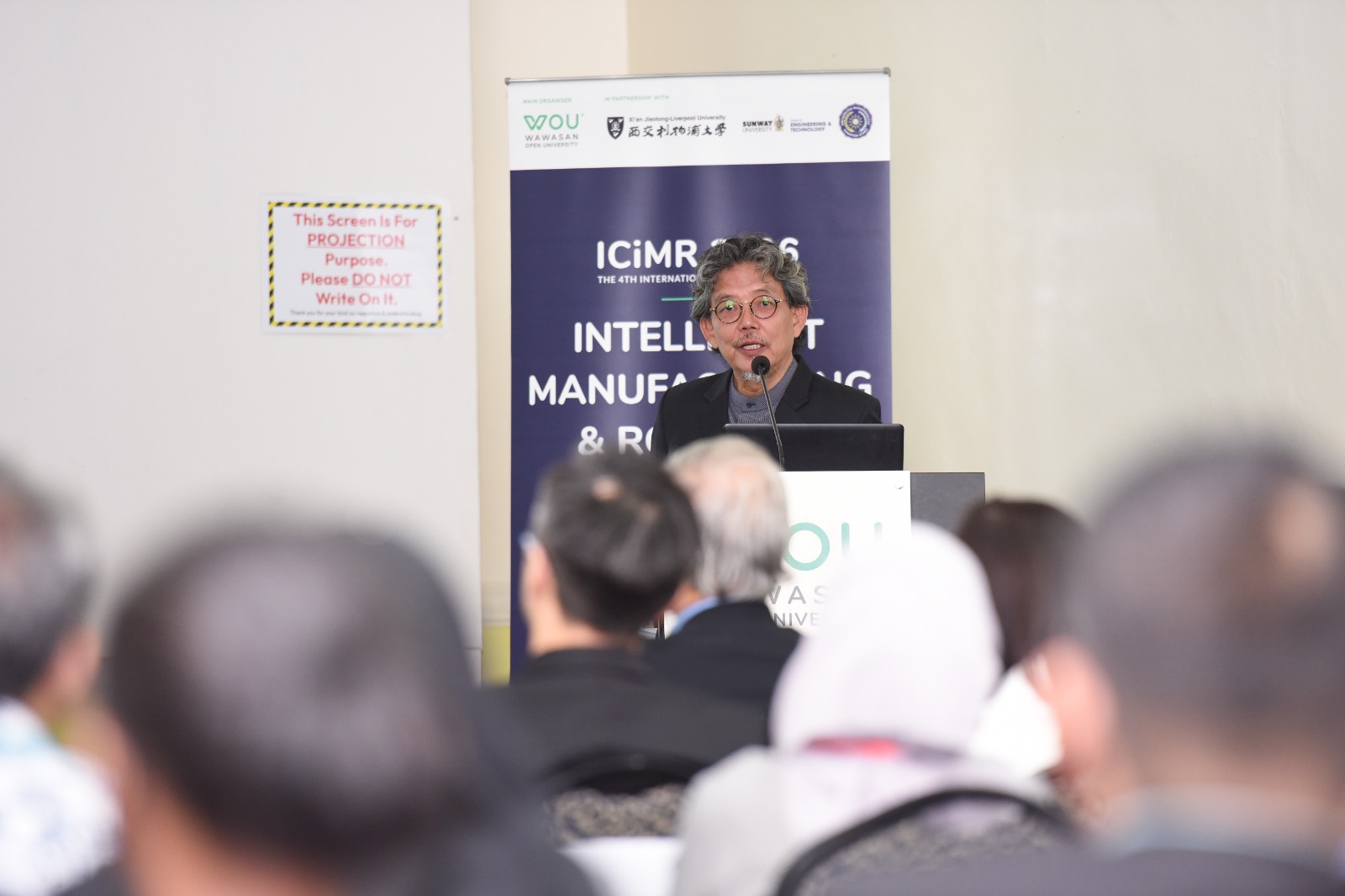
By Ooi Kee Beng, keynote speech at the 4th International Conference on Intelligent Manufacturing and Robotics (ICiMR 2026), organised by Wawasan Open University, Sunway University, Xi-an Jiaotong-Liverpool University and Universitas Muhammadiayh Sumatera Utara.
Now, what I think about on any normal day would be in the area of Malaysian politics, policymaking in Penang, and in recent times, more and more about geopolitical changes and what I would consider to be later-stage decolonisation.
Where high-end manufacturing is concerned, my institute at most may have some discussion now and then that is tangential to intelligent manufacturing and robotics. But that’s about it.
Therefore, I shall not try to preach the Bible to the Pope, I shall not talk about things that the members of my audience today are experts in. Instead, let me talk about what I see as key changes happening in the world today, and in our region; I shall talk about what I think a lot about, that will have or has, great implications for the global economy, for investment flows, and on the nature of supply chains.
_____________
The key term in geopolitics and geo-economics today is “Supply Chain”. It is a term all of you use every day without problematising it or thinking about its usages and history.
You can easily see that the term is military in origin or at least used to express vulnerability in the sustaining of any project happening over long distances. Apparently, the term came into mass media use in 1905 in The Independent, in discussing how the British Army was to be sustained in their expedition into Tibet. By the Second World War, the original military sense of the term, connoting the larger concerns of vulnerability, complexity and strategy, had been sufficiently captured by “Logistics” instead. Industry leaders now realized how analytics used in military logistics could improve business processes.
The term “Supply Chain” came to be used fully in the commercial sense, to describe the path a product takes from raw material to factory, to port, to market, including all the processes servicing that flow. A corporate matter, something managers of companies think about.
At the same time, how the dynamics of that chain drive the growth of an industry over time became its own field of study which some of you may be familiar with: “Industrial dynamics”; that is the study of how whole industries evolve, covering firm entry, growth and exit, technological change, and industry life cycles.
This conceptual division into at least three levels—examining production and sales, tracking industry-wide change, and safeguarding and projecting power—largely reflects Western dominance since the mid-20th century, expressed through soft power, economic and military strength—and global hegemony.
The creation of a global hegemony—as the combined result of the parallel processes of global colonisation, modernisation and globalisation in general, driven by Western powers—requires us today to consider supply chains as a woven tapestry manifesting attaining Western global hegemony in all areas of human endeavours, not only military, economic or economic, but all of them at once.
In our time, that conceptual separation has ended. We are indeed in a global trade war, notable in how the abovementioned cousin concepts have melded together.
More than that, I argue that we are in a period of Late-stage Decolonisation and the Decline of Western Hegemony. One may use those words within economics or politics, or in political economy. But it seems to me that the proper context for them now, is in geopolitical economics.
This leads to broaden the term “Supply chain” as broadly as possible.
I suggest that we think of all global activities involved huge funds to be considered supply chains. Not only that; these are also lines of power and influence, created by various means over long periods of time across the globe, often tentatively and opportunistically, and sometimes through long-term planning and manipulation.
Supply chains as military constructions involve commodities, and usually moving in one direction from base to battlefield. Once the war is won, the situation changes. With invasion and conquest, economic activity and dynamics become more multi-directional. Colonisation is perhaps the right term for this later process.
When considered as acts of power, the creation of supply chains must necessarily involve the creation of authority and predictability, as well as agreements between the parties involved, whether coerced or not.
Therefore, it is reasonable—in fact, unavoidable—that we should apply the term “supply chain” in a very literal sense, to the infrastructure writ large that affects and effectuates the movement of a commodity. By infrastructure writ large, I mean to include not only physical constructions like ports, roads and airports, but also terms and processes of payment and currency control, military and paramilitary resources, sources of energy, trade routes, security, terms of payment, and legal and administrative agreements. The list goes on. Anything we can consider an industry, such as mass media or education, weapons and knowledge in general, is describable as a supply chain.
As the sea within which all these industries interact, is the maintenance of a global discourse and network of agreements, which generates and sufficiently justifies the global hegemony itself.
Where the sustaining of power is concerned, these supply chains cannot be of equal strategic or economic value. Thus, they are defended with different levels of urgency.
The challenge being mounted against Western hegemony today comes on many fronts at the same time. Looking back, that is the only way a challenge to global hegemony can come about, and it also reminds us that global hegemony evolved and had had to evolve—multi-frontally and on a global scale over a long period of time.
_____________
Let me now be less abstract now, and bring in examples of how supply chains are developed, and how how supplies are chained, if you like. Let us look at British Malaya itself. This was the most lucrative of Britain’s colonies at certain periods of time.
Through the late 19th and 20th centuries, the tin industry became one of the most concentrated, politically managed commodities in the world. Notably, the London Metal Exchange began trading Tin in 1870. “Straits tin” became a standard term. However, Chinese labour-intensive methods for mining were soon overwhelmed by capital-intensive ones from the British. As always, technology by won out. By the 1930s, 2/3 of production came from European-owned mines. The supply chain was slowly secured.
The industrial twin to Tin in Malaya was Rubber. Rubber seeds from Brazil had been taken to Kew Gardens in 1876, then sent to Singapore Botanic Gardens. Henry Ridley, who transported the seeds also developed a way of tapping the trees without killing them. The first commercial rubber estate was started in Malacca in 1896, and spread since then throughout the region and to Africa.
The Rubber Research Institute of Malaya (1925) made Malaya the scientific centre of the industry. Germany, cut off from imports, experimented with synthetic “methyl rubber” in WWI and developed Buna rubber in the 1930s. The Soviet Union built its own synthetic industry.
The real shock came in 1941–42, when Japan seized Malaya and the Dutch East Indies, which held about 90% of the world’s natural rubber. The US responded with a crash programme for synthetic rubber made from petroleum (GR-S, a styrene-butadiene rubber). It went from almost nothing to about 800,000 tonnes a year by 1945, one of the great industrial mobilisations of the war. Synthetic rubber overtook natural rubber in volume by the early 1960s.
Tin and Rubber are two examples of how supply chains are created, fought over, maintained through “intelligent manufacturing”, to use today’s phrase, and evolved to accommodate strategic purposes. Also, the geopolitical backdrop should not be ignored in these narratives.
Let’s study another commodity that involved the Malay Peninsula greatly. Let’s look at the Opium trade.
The British were having a trade deficit with China that could not be maintained. The MacArtney expedition to see the Qianlong Emperor in 1794 failed to solve this. Meanwhile, in Bengal, the British had gained company monopoly over the commodity in 1797. The creation of the opium supply chain is a masterclass in itself. Gain a monopoly over its production through licensing, funding and political control, standardize the product, and outsource shipping and smuggling to private “country traders”, with help from local partners. When the opium trade was threatened by a pushback by China, the main market, the military is brought in to settle the issue and to gain control over the ultimate market for the product. This chain came apart because China began supplying itself. And domestic production exceeded imports by the 1900s.
In summary, let me make some points about the intimate connections between supply chains and global hegemony, as well as the nature of colonization and decolonization.
- Firstly, supply chains considered as geopolitical and geo-economic tools of strategy requires us to consider all huge flows of money as a supply chain, as having to do with some commodity being produced and transported, and bought and sold.
- These have different strategic power, and therefore controlling certain ones are more vital to a hegemony than controlling some others.
- Basically therefore, studying the configurations of power as exercised through supply chains understood in this way, is vital to understanding international tensions in an age of hegemonic decline
- Colonisation was the creation and control of supply chains, of traditional products at first, and then of new products as globalization, industrialization and technology evolved. It involves the political economy of expanding European “national empire”, as well as regional control and control of trade routes.
- Decolonisation—often understood as the founding of nation states often based on the liberation of colonial territories—is thus necessarily a regional, or sub-global undertaking, involving supply chain struggles and role play.
We see these dynamics at play with the Rise of Imperial Japan, in the Flying Geese; and even in the necessary formation of ASEAN, and indeed of what I see as its ultimate achievement, the creation of RCEP, mirroring to an extent, BRICS, the SCO, the BRI from the Chinese side. The Asian Financial Crisis itself was clearly a stumble in a process of regional decolonization.
Intelligent manufacturing and robotics require huge investments over a substantial period of time, and are thus very concerned about political security and international tensions. What I talked about today has great relevance to that discussion for that reason. Geopolitics and geo-economics, what I would call Geopolitical Economics, is something everyone today has to be interested in. whether you are an international businessman, a politician or a grey-haired professor.
Two last points I wish to leave you with:
- China’s Rise has strangely been revelatory of the conceptual and geoeconomic limits of 20th century nation-building and national independence
- Meanwhile, Donald Trump’s pressidency has been revelatory of the present weaknesses of the West
As they say, “cometh the hour, cometh the man”. Now I know that phrase is always used to highlight the rise of an impactful leader in a time of crisis. But that claim also applies on the negative side of things. The chaos in global affairs at the moment reflects crisis in the West. And that crisis—that hour—brings forth the man. And that would be President Trump. For some, he is the cure, for others, he is the expression, the embodiment, of that crisis.


Discussion
No comments yet.