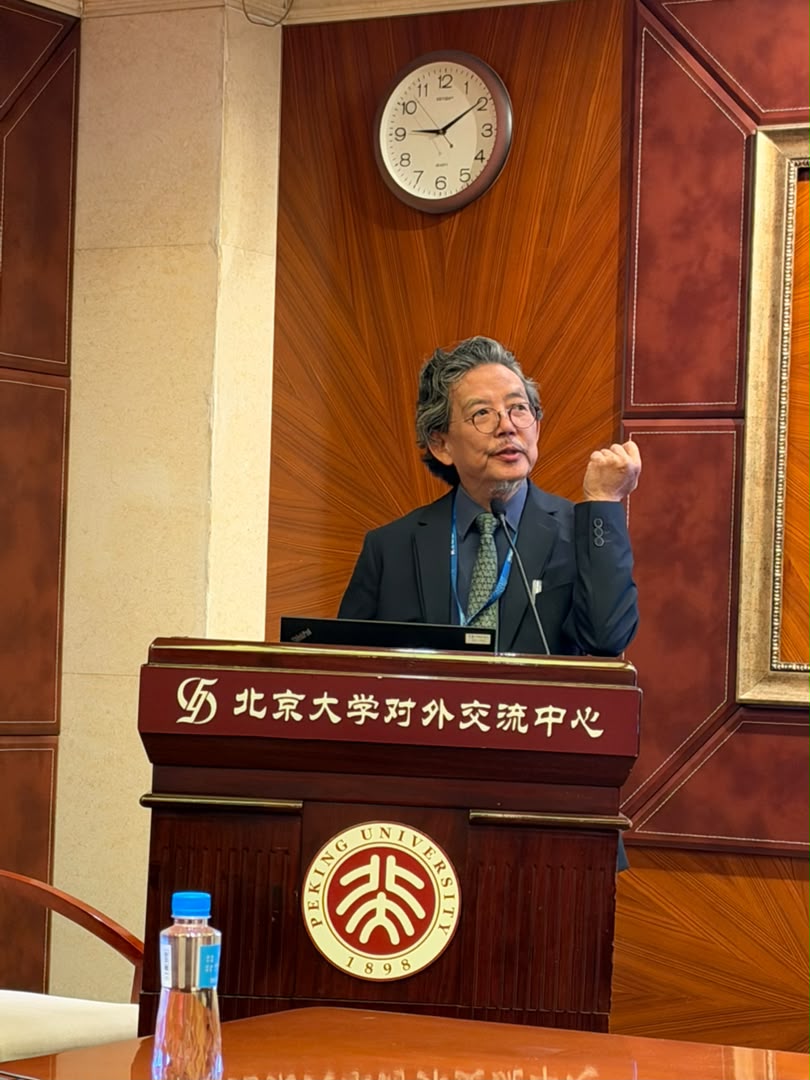
By Ooi Kee Beng, panel speech given at the Beijing Forum 2026 held at Peking University on 6-9 November 2026.
Introduction
Global trade occurring with the intensity and geographical reach of the last few hundred years has been a world-transforming phenomenon. That intensity is not merely economic. Far from it. The beginnings of global trade were piratical and military; it was confrontational and genocidal, and often culturicidal as well. Colonial economics was economic warfare in essence.
Despite its inherent aggression, colonialism over time sought stability and predictability like all economic structures tend to do. And so, conflicts were ideologized, governance systematized, and stresses subdued. Ethical principles were imagined, such as “The White Man’s Burden”, Christian missionary ambitions, or ln post-colonial times, liberation through democracy, and these whitewashed and excused the greed and the violence that had manipulated the global economy and grounded the coercive language of modern international relations. Two key terms inform this essay—Hegemony, and Supply Chains, and are the pillars on which global power and influence sit.
Dominance is the visible power category: this is usually based on the show or threat of military force, economic coercion or direct control, against a weaker party. Hegemony, as theorized by Antonio Gramsci, is subtler. It requires the participation and consent of those dominated. It is woven into everyday cultural life, so that the dominated come to see the order as natural, legitimate or even beneficial, even as it mainly serves the dominant power.
That consent is manufactured and sustained through media, educational institutions, popular narratives and the resultant “common sense”. This article connects the notion of “supply chains” understood in an expanded sense informed by the requirements of global power, to Gramsci’s insights on hegemony. In short, it seeks to connect intimately, global hegemony to the creation and control of supply chains, writ large.
Reeling East Asia into the Hegemonic World Order
It was as late as in 1793 that Britain’s King George III sent George Macartney to China to persuade the Qianlong Emperor to open up China to trade with Britain. The emperor’s blanket rejection of all their requests reminds us that there was as yet no global trade structure in place to speak of. After all, the Manchu empire, which did not wish to import from the West, was at that time the largest economy in the world, responsible for 30% of the estimated global gross domestic product. Having used these figures for comparison, I would add that we are still not talking about a global economy, even if British merchants had been buying huge quantities of silk, ceramics and tea to import into Britain and Europe.
Add to that the solemn fact that the other major polities in northeastern Asia, like Japan, would remain outside world trade until 1854 and Korea until 1876 — the first crumbled under American pressure and the latter in the face of Meiji Japanese expansion.
The Qing Empire itself had to open its ports in 1842 after the First Opium War, with the loss of Hong Kong Island. From then on, its systemic collapse began by way of the Unequal Treaties and Western invasions, as well as internal revolts and revolutions, followed by Japanese invasions. China’s rejuvenation as a major economic power through gaining increasing control over global supply chains as part of a trading network, would not happen until 200 years after the Qianlong Emperor’s fateful rejection of European imports.
The history of colonial economics of the Malay Peninsula, stretching into the national economy-building process of the Malaysian federation, reflects this process of colonial supply chain destruction and creation. British creation of new supply chains making full use of the resources that the Malay peninsula had to offer directed the nature of the latter’s colonization, and of its political economy. The modern demand for tin and rubber encouraged British to extend their control of harbours such as Penang, Malacca and Singapore into the creation of plantations and mines. Increased demand for such commodities prompted the British to exert control over the peninsula—not so much over politics as over their supply chains. This occurred under the greater dynamics of regional supply chains, especially opium which further sentenced India into being a producer colony and China into a black market.
Hegemony was not built in a day but has been an ongoing cultural and ideological project. Instruments of power, when repeated and normalized, stop being seen as instruments. They become “the way things are.” This shifts attention from the visible apparatus of dominance (bases, fleets, sanctions) to the less visible and more durable apparatus of consent and economic colonization.
What we came to call “soft power” in recent years is but the tail-end in global hegemonic rationalization. Beyond that stage, hegemonic disintegration gets more violent.
Supply Chains as a Widened Conceptual Framework
This essay argues that global hegemony, from the British Empire to the American-led order since the 1940s and its present contested moment, is best revealed through a study of supply chains writ large, and how they are controlled. Supply chains are not only a process of moving goods and commodities. It is the whole architecture of supply chains that sustains a dominant power, or a world order, as that power is prone to call it: its military industry and alliances, its education and information flows, its finance and payment systems, its discursive dominance, its infrastructure of all kinds, now including cyber, and its command of trade routes. Each is a chain with chokepoints, and each is held in place by consent as well as by force.
Supply chains cannot only be about commodities. In fact, wherever huge money flows occur, there is a nascent supply chain, if not a mature one.
Understanding supply chains to be about commodities alone is what misguides us in understanding the structure of global power. As power grows, it seeks to be hegemonic. That state of mind is prone to see sub-global challenges everywhere. This defensiveness is paranoid and aggressive, culminating in a world punctured by endless wars, when not world wars.
The necessary connection between geo-economics and global hegemony calls for attention to be paid to supply chains being understood in such a way that tools of power and the flow of goods are interwoven analytically.
This can be in education, information and messaging; in finance and global payments, in laws and regulations, in defence and ideological alliances, in entertainment and language use, and so on and so forth.
Widened this way conceptually, the supply chain becomes a model for how knowledge, talent, capital, legitimacy and technological capability function together to provide a degree of global stability. In fact, it illuminates hegemony in at least three respects.
First, it shows how hegemony is constructed. A hegemon positions itself at the chokepoints of the networks through which value is created: advanced chip design, the currency of trade, the platforms of information, the standards everyone must meet, and the payment rails everyone must use. This was the logic of British shipping insurance, rubber seedlings and oil concessions, and it is the logic of American chip design software, advanced lithography and dollar clearing today.
Second, it shows what that hegemony is like. Because control operates through chokepoints in distributed systems rather than territorial rule, it is diffuse, often invisible, and reliant on the Gramscian mix of coercion and consent. Nations join dollar trade, American-designed standards and American-underwritten security not only because they must, but because exclusion costs more than participation. Consent is reproduced by making exit prohibitively expensive.
Third, it explains when a hegemon moves from routine maintenance to desperate, visible defense.
Beyond control of commodity flows, which implies certain contingent priorities, hegemony operates more fluidly through interlocking layers, each with its own chokepoints:
- Military industry and alliances. This involves naval power, arsenals and defense-industrial capacity, plus the alliance networks that supply, interoperate with and depend on them. Britain relied on the Royal Navy and its imperial ports; the United States on NATO, its Pacific alliances and a defense-industrial base that equips partners and locks in their dependence.
- Education. Institutions are required which train elites and diffuse technique and worldview. Oxbridge and imperial schooling once played this role; today this function is carried out by American Ivy League and such universities. Global discourses are generated into being which act as the foundation for “The World Order” and the stability of its many supply chains.
- Finance. Institutions are established which allocate capital and set the terms of exchange: the City of London and sterling, then Bretton Woods, the IMF and the dollar’s reserve role.
- Information. The channels through which knowledge and news flow: telegraph cables and wire services yesterday; platforms, technical standards and chip design software today.
- Payment systems. The plumbing of settlement, from sterling bills and London-underwritten insurance to dollar clearing, SWIFT messaging and correspondent banking, where access can be granted or withdrawn.
- Infrastructure. The physical backbone: coaling stations and canals then; ports, satellites, undersea cables and fabrication plants now.
- Trade routes. The sea lanes and straits through which goods move, secured by imperial navies and, later, by an American-underwritten regime of freedom of navigation and containerized shipping.
A hegemon does not control every link. It controls what it sees as critical ones, or ones must easily threatened with subsequent serious repercussions.
A Historical Review: Britain’s Supply-Chain Hegemony
British power was never only naval supremacy. It was the construction and control of chokepoints across global supply chains that moved goods, labor, narcotics and eventually energy, each with an ideological apparatus to manufacture consent.
The Atlantic slave trade was literally a supply chain: manufactured goods to West Africa, enslaved people to the Americas, sugar, cotton and tobacco back to Britain. Britain held the chokepoints of shipping, London-underwritten insurance, plantation finance, and refining and re-export, while the labor and the human cost sat elsewhere. Consent was cultivated through emergent racial pseudo-science and Christian doctrine, with the imperative to “baptize” or “civilize” recasting coerced labour as moral uplift.
Opium shows chokepoint control used to force open a closed market. The East India Company grew opium in Bengal under monopoly and exported it to China, reversing the silver drain caused by European demand for tea, silk and porcelain. When the Qing tried to stop a trade that was both a public-health catastrophe and an instrument of subordination, Britain fought two wars, winning treaty ports, extraterritorial privileges, and Hong Kong.
Rubber and tin show deliberate relocation of a resource chain. Henry Wickham smuggled Amazonian rubber seeds to British Malaya and Ceylon. Within decades Southeast Asia had displaced Brazil by means of a plantation system built on indentured and migrant labour. Malayan tin followed the same logic, with British capital and colonial governance subordinating local production to London markets. Legitimation came from the civilizational narrative of Kipling’s 1899 “The White Man’s Burden,” which recast extraction as a reluctant duty.
Oil is the transitional case. The Anglo-Persian Oil Company (1909) put Britain at a chokepoint of growing strategic value once the Royal Navy converted from coal to oil under Churchill. Control was extended through arrangements such as the Red Line Agreement and defended through colonial administration, client rulers and a rhetoric of stewardship and modernization. Primacy passed to American firms and guarantees after 1945, epitomized by Roosevelt’s meeting with King Abdulaziz aboard the USS Quincy. The hegemonic succession works like this: not a single transfer of power but a renegotiation of who controls the chokepoints of an existing chain, with a new ideology (Cold War anti-communism, then modernization theory) to secure consent for the successor.
Across these cases the pattern holds. Material control of chokepoints (shipping lanes, plantation labor, smuggled seedlings, oil concessions) is always accompanied by an ideological superstructure whose function is constitutive, not incidental. Guns and charters could secure a chain temporarily; the narrative, absorbed into the common sense of colonizer and colonized, made the order hegemonic.
A Historical Review: What Produced American Hegemony?
The empirical question is what conditions had to be achieved for American hegemony to be established globally and sustained through consent rather than coercion alone. Military supremacy mattered but cannot be the whole answer. The answer lies in layered institutions: the Bretton Woods financial architecture and the dollar’s reserve role, the network of security alliances, multilateral trade regimes, international law and organizations, and universities and research systems that drew in and diffused talent. Together they produced a widely, if unevenly, accepted American-centred order. Participation was often actively desired, because it offered markets, security, technological diffusion and a template of modernization. The accompanying ideology was liberal internationalism (free markets, development, human rights), doing the work Christian mission and civilizational stewardship had done for Britain.
The creation of the petrodollar in 1974 by the US was a stroke of genius meant secure control over two vital ends of the global trade structure: Global supply of energy on the one hand and global finance and payments on the other.
Moving forward, how critical supply chains—from rare earths and oil to information and finance—are to be managed in order for trade wars to be limited and military warfare avoided, will require general understanding and open discussions about historical global hegemonic practices. If not, we remain victims of the exigencies and foul practices that gave birth to antagonistic and hegemonic global trade.
The contest over semiconductors, popularized as the “chip war,” exemplifies a shift in control over the supply chain. For decades, American maintenance of hegemony here was routine and largely invisible: standard-setting, intellectual property licensing, offshoring fabrication to allies such as Taiwan and South Korea, and the ordinary operations of ASML, Applied Materials and Nvidia. American and aligned firms held the irreplaceable chokepoints of chip design, electronic design automation and extreme ultraviolet lithography, and the world participated because participation paid.
That posture changed when China’s industrial policy for semiconductor self-sufficiency offered an alternative chain bypassing those chokepoints. The response included export controls on advanced chips and equipment since 2022, limits on ASML’s EUV lithography sales, reshoring subsidies such as the CHIPS and Science Act, and pressure on allies to align their own controls. These are not the actions of a confident hegemon in routine maintenance. Instead, they mark a shift from the quiet architecture of consent to the overt architecture of restriction. And the rhetoric shifted with it, from open markets to national security and “de-risking”.
In turn, the case of rare earths reveals a chokepoint held by the challenger. China’s dominance in mining and, more decisively, refining of the elements needed for the magnets needed for electric vehicles, wind turbines and precision-guided munitions gives Beijing a position analogous to Britain’s over rubber or America’s over lithography. Periodic tightening of export licenses in moments of tension turns chokepoint control into coercive leverage with minimal military force. The American and allied response (allied mining and separation capacity, stockpiling, and diversification deals with countries such as Australia and Vietnam) builds redundancy into a chain where a rival holds disproportionate control.
Both cases show that the shift from maintenance to defense is legible through the supply-chain lens in a way military or ideological analysis alone would miss. The signal is not a change in stated values or a sudden mobilization. It is the tightening of technical chokepoints (export licenses, equipment restrictions, entity lists, subsidized reshoring), small technocratic acts that together reveal a power recognizing that its apparatus of consent no longer suffices and that coercive instruments, normally held in reserve, must be shown more often.
If this analysis holds, it also carries a normative implication. An order built only on chokepoint control and manufactured consent is fragile, because it depends on the continuous suppression of alternatives, as Britain learned when rubber slipped beyond its monopoly and as the United States is discovering against a peer competitor in chips and critical minerals. A stabler and fairer order would structure supply chains—meaning knowledge, talent, capital, finance, information and infrastructure alike—for redundancy and shared access rather than singular chokepoint control.
Power differentials between states would remain, but they would depend less on the deliberate foreclosure of others’ development. It would look less like one hegemon defending its chokepoints and more like a multipolar network of interdependent capabilities, in which the natural tendency toward the diffusion of knowledge operates with fewer government-imposed obstructions, and legitimacy is earned through mutual benefit rather than manufactured through dependency.
In essence, there has been an abundance of trade wars in modern times, largely driven by colonial ambitions. Global hegemony evolved into a different form with the coming of post-colonial nation states. Indeed, an Olympian paradox of our times is that the Westphalian solution crafted in Europe and which encouraged the rise of global colonization, would become the preferred model for the political liberation of decolonizing territories.
This diversity of national voices is not the biggest challenge to the hegemonic niceties of the West.


Discussion
No comments yet.