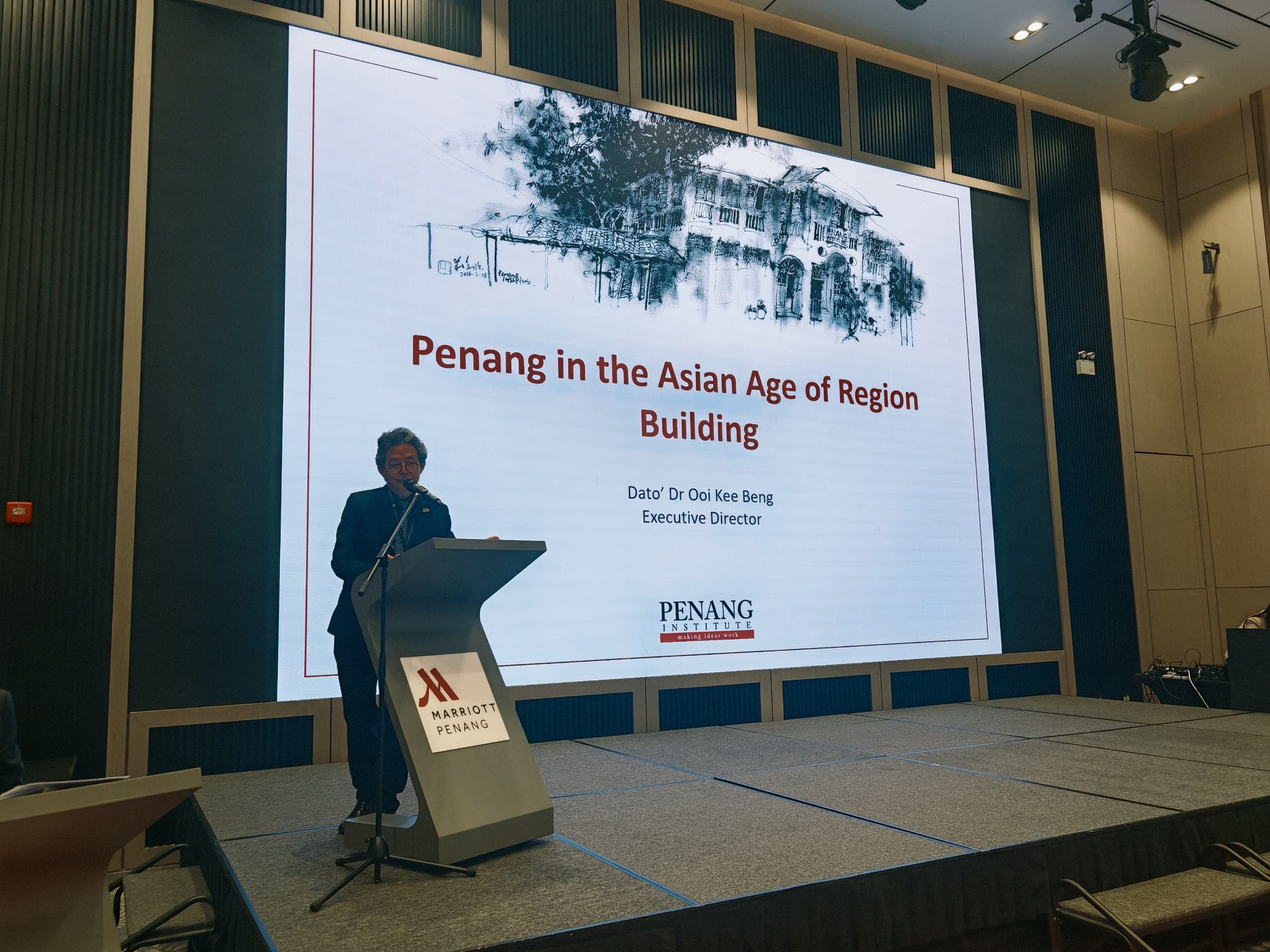
By Dato’ Dr Ooi Kee Beng (Opening keynote speech given at the 5th Penang International Hanwang Forum “Digital Silk Road: Connecting a Resilient Future) on 13 November 2026 at Penang Marriott Hotel.
STAND FOR A moment at the western end of Lebuh Pitt within George Town. Walk down a few hundred steps and you pass an Indian Muslim mosque, a Hindu temple, a Chinese temple, and an Anglican church. Locals proudly call this stretch of road “The Street of Harmony”. Visitors call it “Charismatic and Charming”. I want to suggest that it is something more than either. That street reflects a complex reality of managing adversity and diversity, poverty and politics, for over 240 years.
For more than two centuries, Penang has survived and prospered by doing one thing well: being a place where people, goods and ideas from many parts of the world can congregate without fighting, and instead learn to trade with each other, eat with each other, and even marry each other. Their culinary dishes fused, and they thrived and suffered together through disease, poverty and foreign occupation.
Each community learned to trust the others, creating a tight social ecosystem. That was its achievement already during colonial times. After independence, that spirit saw Penang develop into the economic powerhouse it is today. In the multipolar age, Penang will be more at home than ever before.
That is my argument tonight. Penang is not a small island waiting to see who wins. Penang is a cosmopolis ready to take its place in a peaceful multipolar future.
Penang was a crossroads before it was anything else. After the English East India Company took the island in 1786, they began running it as a free port, for want of sufficient resources to run it any other way. Habits befitting a vibrant, ethnically diverse free-port economy quickly grew over the next 240 years, forming what we now recognize as “Penang culture”.
Penang sits where the Andaman Sea, the Indian Ocean and the Straits of Melaka meet. Its inhabitants worked the regional trade with Siam and Burma, Kedah and the Malay peninsula, and Aceh and the rest of Sumatra. Not to forget places further afield.
Nearly everyone arrived by boat: from Sumatra or Sulawesi, from China or India, from Europe or the Middle East. A port-based economy never lets you forget how vast and varied the planet is; the signs of the larger world are present everywhere in Penang’s daily life. Penang, in a phrase, is insular yet global. That insularity allows it to develop its own brand of cosmopolitanism, while its globality keeps it always cognizant of worldly opportunities.
Ladies and Gentlemen:
This is the foundation for the adaptability and resilience of its people and its economy.
What makes Penang rare is not only that its many communities live peacefully side by side. It is that no single community can reasonably claim the right to dominate its neighbours.
Most famous cosmopolises are the showcase city of their country’s ethnic majority. Penang comes close to the ideal kind of cosmopolis where the evolution of its culture and economy is a project common to its whole population, and not the privilege of any one ethnic group.
Penang’s story is also a lesson in surviving losses in political stature and importance. Singapore, founded in 1819, 33 years after the British took over Penang, overtook Penang’s principal position within a generation, and Penang lost its British India presidency status in 1830.
This was a blessing in the long run. Somewhat sidelined in the British scheme for global expansion, Penang was allowed to develop further from the bottom up, from the daily struggles of its inhabitants, from them absorbing cultural impulses from each other.
A hard blow came after independence. Penang had been where Malaya’s first municipal election was held, and it was granted city status by the departing British in January 1957—the only Malayan settlement to hold that title. But then, in the 1960s, local elections were abolished in the country, and in 1969, Penang’s free port status was taken away too, due to the centralising trend in nation-building entertained at the political centre in Kuala Lumpur. Unemployment soared in Penang in the late 1960s and early 70s. I went overseas at that time in search of opportunities.
Despite its historical relevance, Penang was in real danger of becoming inconsequential—as geo-economic and multicultural hub.
Luckily, that did not happen. Penang managed to turn things around rather quickly. Its economy reconnected with the world. Under Chief Minister Tun Dr Lim Chong Eu, aided by his right-hand man Dato’ Seri Chet Singh (who sadly passed away at 90 years old last Tuesday, three days ago), Penang established Malaysia’s first free trade zones in the early 1970s, and soon joined the electronics revolution taking place in the world, and earned the title “Silicon Valley of the East.”
It has been deeply international and cosmopolitan since Day One, and deeply multicultural since Day One. Its economic shifts reflect this history
Penang’s strong spider-web connections to the world and cognizance of the world, did not disappoint. That is the hat it can pull rabbits out of, like a good magician. Ignore that fact, and you may not understand how the place works, and how it remains so resilient and adaptive.
Today, Penang’s economy depends very much on its two E&Es: its electrical and electronics manufacturing, and its experiential and ecological tourism. The first took 55 years to build; the second has been megaphoned in importance by UNESCO’s recognition of George Town’s heritage in 2008 and of Penang Hill Biodiversity in 2021.
Ladies and Gentlemen:
The world is changing again, and in short, multipolarity is becoming a reality.
The many poles are already visible: We have China of course; then an India that looks unstoppable; a Brazil drumming for BRICS; regional centres in the Muslim world and in Africa; and a Europe seeking to find its own global path.
In such a world, Penang should fit in comfortably. Its international connections and its multicultural population provide advantages that few other cities have.
How can it make full use of these advantages?
- Placemaking Penang in the world. Penang has a strong geopolitical history and it should continue to globalise its self-image and enhance its international relevance in as many fields as possible. Its multiculturalism already provides it with easy entry points into most parts of the world. It is a welcoming cultural hub, well located, and representing major ethnic groups in the region.
- Investing in education. With its heritage and network of good schools catering to all ethnicities, its many publishers and printers, and its highly educated population, the education industry holds great potential for Penang to play a strong regional role in the future.
- Investing in liveability. Politically and socially stable, Penang is often ranked as one of the most appreciated places to live, work or retire to. It is welcoming of ethnic and cultural diversity, it has good food, it is well-served by international travel routes. Farsighted visionary planning that creates more third-spaces and cultural spaces would attract the talents that it needs and help it retain the talents it creates locally.
- Pairing development with sustainability. This is not as limiting a path to take as it might seem. In fact, thinking in sustainability terms should prove to be inspirational and generate innovativeness. Penang’s heritage and biodiversity are two values that Penang’s reputation is built on.
Ladies and gentlemen:
The forces reshaping the world invites us to have a regional conversation that has for geopolitical reasons been postponed for too long. I am convinced that Penang is well-placed to host such conversations.
Region building is necessarily the next strategic step for Penang and Malaysia to take. In fact, the region as a whole is moving beyond the narrow nation-building agendas it has been struggling with over the last 70 years.
While writing this speech, I re-titled it from the advertised “Penang in the Multipolar World” to “Penang in the Asian Age of Region Building”. I wish to highlight that point: Multipolarity is about Region building, not about Geopolitical polarizing. Going forward, we in this part of Asia should think as much in terms of Region-building as of Nation-building, if not more so.Penang in the Age of Asian Region Building
By Dato’ Dr Ooi Kee Beng
STAND FOR A moment at the western end of Lebuh Pitt within George Town. Walk down a few hundred steps and you pass an Indian Muslim mosque, a Hindu temple, a Chinese temple, and an Anglican church. Locals proudly call this stretch of road “The Street of Harmony”. Visitors call it “Charismatic and Charming”. I want to suggest that it is something more than either. That street reflects a complex reality of managing adversity and diversity, poverty and politics, for over 240 years.
For more than two centuries, Penang has survived and prospered by doing one thing well: being a place where people, goods and ideas from many parts of the world can congregate without fighting, and instead learn to trade with each other, eat with each other, and even marry each other. Their culinary dishes fused, and they thrived and suffered together through disease, poverty and foreign occupation.
Each community learned to trust the others, creating a tight social ecosystem. That was its achievement already during colonial times. After independence, that spirit saw Penang develop into the economic powerhouse it is today. In the multipolar age, Penang will be more at home than ever before.
That is my argument tonight. Penang is not a small island waiting to see who wins. Penang is a cosmopolis ready to take its place in a peaceful multipolar future.
Penang was a crossroads before it was anything else. After the English East India Company took the island in 1786, they began running it as a free port, for want of sufficient resources to run it any other way. Habits befitting a vibrant, ethnically diverse free-port economy quickly grew over the next 240 years, forming what we now recognize as “Penang culture”.
Penang sits where the Andaman Sea, the Indian Ocean and the Straits of Melaka meet. Its inhabitants worked the regional trade with Siam and Burma, Kedah and the Malay peninsula, and Aceh and the rest of Sumatra. Not to forget places further afield.
Nearly everyone arrived by boat: from Sumatra or Sulawesi, from China or India, from Europe or the Middle East. A port-based economy never lets you forget how vast and varied the planet is; the signs of the larger world are present everywhere in Penang’s daily life. Penang, in a phrase, is insular yet global. That insularity allows it to develop its own brand of cosmopolitanism, while its globality keeps it always cognizant of worldly opportunities.
Ladies and Gentlemen:
This is the foundation for the adaptability and resilience of its people and its economy.
What makes Penang rare is not only that its many communities live peacefully side by side. It is that no single community can reasonably claim the right to dominate its neighbours.
Most famous cosmopolises are the showcase city of their country’s ethnic majority. Penang comes close to the ideal kind of cosmopolis where the evolution of its culture and economy is a project common to its whole population, and not the privilege of any one ethnic group.
Penang’s story is also a lesson in surviving losses in political stature and importance. Singapore, founded in 1819, 33 years after the British took over Penang, overtook Penang’s principal position within a generation, and Penang lost its British India presidency status in 1830.
This was a blessing in the long run. Somewhat sidelined in the British scheme for global expansion, Penang was allowed to develop further from the bottom up, from the daily struggles of its inhabitants, from them absorbing cultural impulses from each other.
A hard blow came after independence. Penang had been where Malaya’s first municipal election was held, and it was granted city status by the departing British in January 1957—the only Malayan settlement to hold that title. But then, in the 1960s, local elections were abolished in the country, and in 1969, Penang’s free port status was taken away too, due to the centralising trend in nation-building entertained at the political centre in Kuala Lumpur. Unemployment soared in Penang in the late 1960s and early 70s. I went overseas at that time in search of opportunities.
Despite its historical relevance, Penang was in real danger of becoming inconsequential—as geo-economic and multicultural hub.
Luckily, that did not happen. Penang managed to turn things around rather quickly. Its economy reconnected with the world. Under Chief Minister Tun Dr Lim Chong Eu, aided by his right-hand man Dato’ Seri Chet Singh (who sadly passed away at 90 years old last Tuesday, three days ago), Penang established Malaysia’s first free trade zones in the early 1970s, and soon joined the electronics revolution taking place in the world, and earned the title “Silicon Valley of the East.”
It has been deeply international and cosmopolitan since Day One, and deeply multicultural since Day One. Its economic shifts reflect this history
Penang’s strong spider-web connections to the world and cognizance of the world, did not disappoint. That is the hat it can pull rabbits out of, like a good magician. Ignore that fact, and you may not understand how the place works, and how it remains so resilient and adaptive.
Today, Penang’s economy depends very much on its two E&Es: its electrical and electronics manufacturing, and its experiential and ecological tourism. The first took 55 years to build; the second has been megaphoned in importance by UNESCO’s recognition of George Town’s heritage in 2008 and of Penang Hill Biodiversity in 2021.
Ladies and Gentlemen:
The world is changing again, and in short, multipolarity is becoming a reality.
The many poles are already visible: We have China of course; then an India that looks unstoppable; a Brazil drumming for BRICS; regional centres in the Muslim world and in Africa; and a Europe seeking to find its own global path.
In such a world, Penang should fit in comfortably. Its international connections and its multicultural population provide advantages that few other cities have.
How can it make full use of these advantages?
- Placemaking Penang in the world. Penang has a strong geopolitical history and it should continue to globalise its self-image and enhance its international relevance in as many fields as possible. Its multiculturalism already provides it with easy entry points into most parts of the world. It is a welcoming cultural hub, well located, and representing major ethnic groups in the region.
- Investing in education. With its heritage and network of good schools catering to all ethnicities, its many publishers and printers, and its highly educated population, the education industry holds great potential for Penang to play a strong regional role in the future.
- Investing in liveability. Politically and socially stable, Penang is often ranked as one of the most appreciated places to live, work or retire to. It is welcoming of ethnic and cultural diversity, it has good food, it is well-served by international travel routes. Farsighted visionary planning that creates more third-spaces and cultural spaces would attract the talents that it needs and help it retain the talents it creates locally.
- Pairing development with sustainability. This is not as limiting a path to take as it might seem. In fact, thinking in sustainability terms should prove to be inspirational and generate innovativeness. Penang’s heritage and biodiversity are two values that Penang’s reputation is built on.
Ladies and gentlemen:
The forces reshaping the world invites us to have a regional conversation that has for geopolitical reasons been postponed for too long. I am convinced that Penang is well-placed to host such conversations.
Region building is necessarily the next strategic step for Penang and Malaysia to take. In fact, the region as a whole is moving beyond the narrow nation-building agendas it has been struggling with over the last 70 years.
While writing this speech, I re-titled it from the advertised “Penang in the Multipolar World” to “Penang in the Asian Age of Region Building”. I wish to highlight that point: Multipolarity is about Region building, not about Geopolitical polarizing. Going forward, we in this part of Asia should think as much in terms of Region-building as of Nation-building, if not more so.By Dato’ Dr Ooi Kee Beng
STAND FOR A moment at the western end of Lebuh Pitt within George Town. Walk down a few hundred steps and you pass an Indian Muslim mosque, a Hindu temple, a Chinese temple, and an Anglican church. Locals proudly call this stretch of road “The Street of Harmony”. Visitors call it “Charismatic and Charming”. I want to suggest that it is something more than either. That street reflects a complex reality of managing adversity and diversity, poverty and politics, for over 240 years.
For more than two centuries, Penang has survived and prospered by doing one thing well: being a place where people, goods and ideas from many parts of the world can congregate without fighting, and instead learn to trade with each other, eat with each other, and even marry each other. Their culinary dishes fused, and they thrived and suffered together through disease, poverty and foreign occupation.
Each community learned to trust the others, creating a tight social ecosystem. That was its achievement already during colonial times. After independence, that spirit saw Penang develop into the economic powerhouse it is today. In the multipolar age, Penang will be more at home than ever before.
That is my argument tonight. Penang is not a small island waiting to see who wins. Penang is a cosmopolis ready to take its place in a peaceful multipolar future.
Penang was a crossroads before it was anything else. After the English East India Company took the island in 1786, they began running it as a free port, for want of sufficient resources to run it any other way. Habits befitting a vibrant, ethnically diverse free-port economy quickly grew over the next 240 years, forming what we now recognize as “Penang culture”.
Penang sits where the Andaman Sea, the Indian Ocean and the Straits of Melaka meet. Its inhabitants worked the regional trade with Siam and Burma, Kedah and the Malay peninsula, and Aceh and the rest of Sumatra. Not to forget places further afield.
Nearly everyone arrived by boat: from Sumatra or Sulawesi, from China or India, from Europe or the Middle East. A port-based economy never lets you forget how vast and varied the planet is; the signs of the larger world are present everywhere in Penang’s daily life. Penang, in a phrase, is insular yet global. That insularity allows it to develop its own brand of cosmopolitanism, while its globality keeps it always cognizant of worldly opportunities.
Ladies and Gentlemen:
This is the foundation for the adaptability and resilience of its people and its economy.
What makes Penang rare is not only that its many communities live peacefully side by side. It is that no single community can reasonably claim the right to dominate its neighbours.
Most famous cosmopolises are the showcase city of their country’s ethnic majority. Penang comes close to the ideal kind of cosmopolis where the evolution of its culture and economy is a project common to its whole population, and not the privilege of any one ethnic group.
Penang’s story is also a lesson in surviving losses in political stature and importance. Singapore, founded in 1819, 33 years after the British took over Penang, overtook Penang’s principal position within a generation, and Penang lost its British India presidency status in 1830.
This was a blessing in the long run. Somewhat sidelined in the British scheme for global expansion, Penang was allowed to develop further from the bottom up, from the daily struggles of its inhabitants, from them absorbing cultural impulses from each other.
A hard blow came after independence. Penang had been where Malaya’s first municipal election was held, and it was granted city status by the departing British in January 1957—the only Malayan settlement to hold that title. But then, in the 1960s, local elections were abolished in the country, and in 1969, Penang’s free port status was taken away too, due to the centralising trend in nation-building entertained at the political centre in Kuala Lumpur. Unemployment soared in Penang in the late 1960s and early 70s. I went overseas at that time in search of opportunities.
Despite its historical relevance, Penang was in real danger of becoming inconsequential—as geo-economic and multicultural hub.
Luckily, that did not happen. Penang managed to turn things around rather quickly. Its economy reconnected with the world. Under Chief Minister Tun Dr Lim Chong Eu, aided by his right-hand man Dato’ Seri Chet Singh (who sadly passed away at 90 years old last Tuesday, three days ago), Penang established Malaysia’s first free trade zones in the early 1970s, and soon joined the electronics revolution taking place in the world, and earned the title “Silicon Valley of the East.”
It has been deeply international and cosmopolitan since Day One, and deeply multicultural since Day One. Its economic shifts reflect this history
Penang’s strong spider-web connections to the world and cognizance of the world, did not disappoint. That is the hat it can pull rabbits out of, like a good magician. Ignore that fact, and you may not understand how the place works, and how it remains so resilient and adaptive.
Today, Penang’s economy depends very much on its two E&Es: its electrical and electronics manufacturing, and its experiential and ecological tourism. The first took 55 years to build; the second has been megaphoned in importance by UNESCO’s recognition of George Town’s heritage in 2008 and of Penang Hill Biodiversity in 2021.
Ladies and Gentlemen:
The world is changing again, and in short, multipolarity is becoming a reality.
The many poles are already visible: We have China of course; then an India that looks unstoppable; a Brazil drumming for BRICS; regional centres in the Muslim world and in Africa; and a Europe seeking to find its own global path.
In such a world, Penang should fit in comfortably. Its international connections and its multicultural population provide advantages that few other cities have.
How can it make full use of these advantages?
- Placemaking Penang in the world. Penang has a strong geopolitical history and it should continue to globalise its self-image and enhance its international relevance in as many fields as possible. Its multiculturalism already provides it with easy entry points into most parts of the world. It is a welcoming cultural hub, well located, and representing major ethnic groups in the region.
- Investing in education. With its heritage and network of good schools catering to all ethnicities, its many publishers and printers, and its highly educated population, the education industry holds great potential for Penang to play a strong regional role in the future.
- Investing in liveability. Politically and socially stable, Penang is often ranked as one of the most appreciated places to live, work or retire to. It is welcoming of ethnic and cultural diversity, it has good food, it is well-served by international travel routes. Farsighted visionary planning that creates more third-spaces and cultural spaces would attract the talents that it needs and help it retain the talents it creates locally.
- Pairing development with sustainability. This is not as limiting a path to take as it might seem. In fact, thinking in sustainability terms should prove to be inspirational and generate innovativeness. Penang’s heritage and biodiversity are two values that Penang’s reputation is built on.
Ladies and gentlemen:
The forces reshaping the world invites us to have a regional conversation that has for geopolitical reasons been postponed for too long. I am convinced that Penang is well-placed to host such conversations.
Region building is necessarily the next strategic step for Penang and Malaysia to take. In fact, the region as a whole is moving beyond the narrow nation-building agendas it has been struggling with over the last 70 years.
While writing this speech, I re-titled it from the advertised “Penang in the Multipolar World” to “Penang in the Asian Age of Region Building”. I wish to highlight that point: Multipolarity is about Region building, not about Geopolitical polarizing. Going forward, we in this part of Asia should think as much in terms of Region-building as of Nation-building, if not more so.


Discussion
No comments yet.